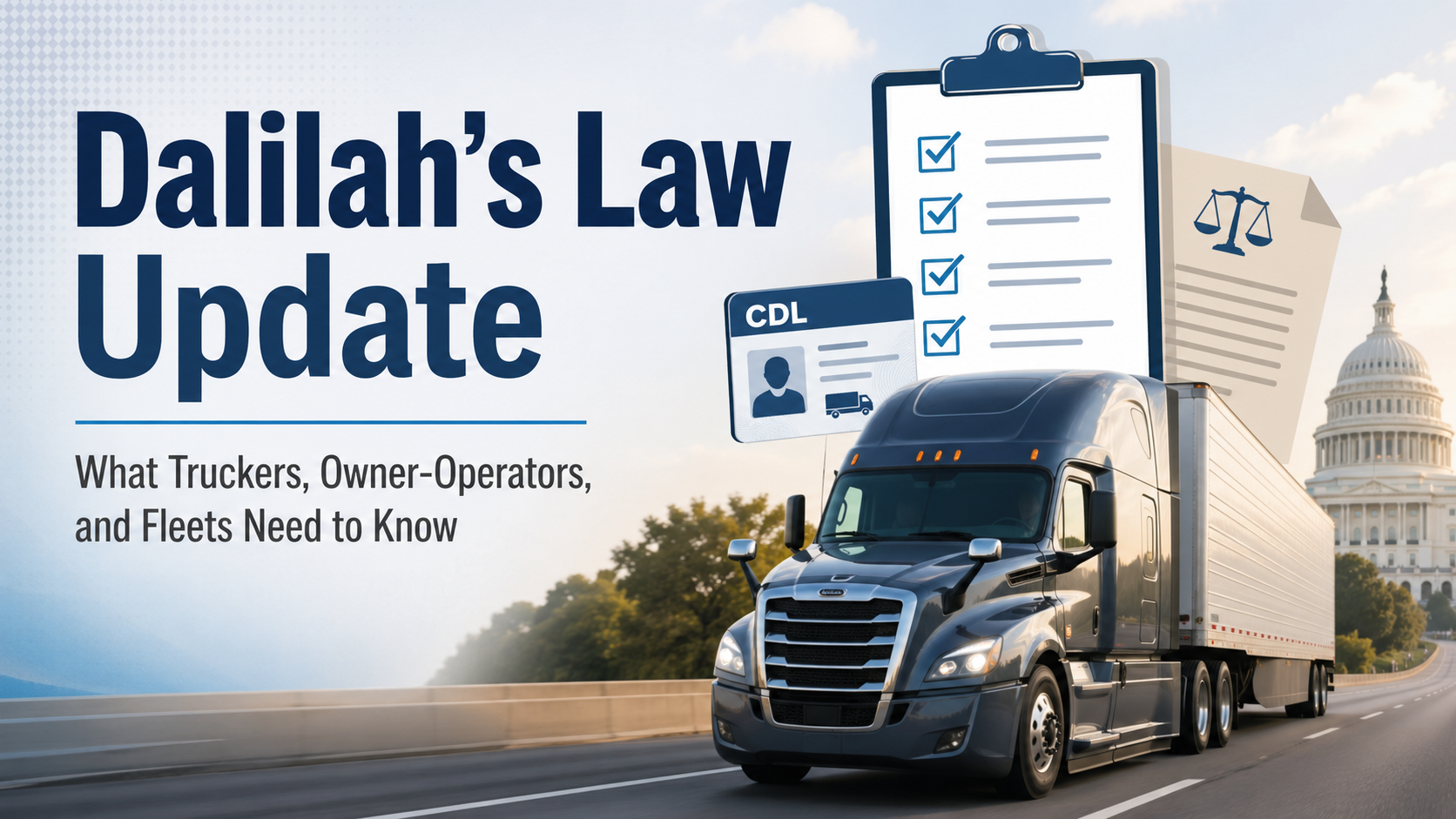
Dalilah’s Law 2026: What Truckers and Carriers Need to Know
Get Your Free Insurance Quote
Compare quotes from top carriers in minutes
Dalilah’s Law 2026 Update: What Truckers and Carriers Need to Know
Dalilah’s Law is getting attention because it could change how commercial driver’s licenses are issued, how English proficiency is enforced, and whether motor carriers can use certain foreign dispatch services.
One important point up front: Dalilah’s Law is not the same thing as the FMCSA final rule that already took effect on March 16, 2026. The FMCSA rule is already active. Dalilah’s Law is proposed federal legislation that would put parts of those CDL changes into statute and add other rules for English testing, state enforcement, dispatch services, brokers, employers, and training providers. FMCSA’s final rule became effective March 16, 2026, and limits non-domiciled CLP/CDL eligibility for foreign-domiciled individuals to specific employment-based nonimmigrant categories.
What Is Dalilah’s Law?
Dalilah’s Law is a federal trucking safety bill named for Dalilah Coleman, a child who was severely injured in a crash involving a tractor-trailer. The House Transportation and Infrastructure Committee approved H.R. 5688, called Dalilah’s Law, on March 18, 2026, and sent it to the full House.
The version that matters most for fleets right now is H.R. 5688, the House bill led by Rep. David Rouzer of North Carolina. It was originally introduced in 2025 as the Non-Domiciled CDL Integrity Act and was later updated under the Dalilah’s Law name. The House committee record shows the bill was approved as amended by a 35-26 vote.
As of the latest public information checked, H.R. 5688 had advanced out of committee but had not become law. That means carriers should watch it closely, but should not treat every proposed section as active law yet.
What Is Already in Effect: FMCSA’s Non-Domiciled CDL Rule
FMCSA’s final rule is already active. It applies to non-domiciled commercial learner’s permits and commercial driver’s licenses, not every CDL holder in the country.
Under the FMCSA final rule, foreign-domiciled drivers are limited to non-domiciled CLP/CDL eligibility if they maintain lawful immigration status in one of these employment-based nonimmigrant categories:
- H-2A Temporary agricultural workers
- H-2BTemporary non-agricultural workers
- E-2Treaty investors
FMCSA said these categories were selected because they are tied to additional driver-history screening, vetting, and employment-based review.
FMCSA’s rule also says a non-domiciled CLP or CDL generally may not be valid longer than the driver’s authorized stay or one year, whichever is shorter.
What Dalilah’s Law Would Change If It Becomes Law
Dalilah’s Law would go beyond the FMCSA rule. The House bill text includes several major pieces that carriers, owner-operators, dispatchers, and CDL schools should understand.
1. English-Only CDL Knowledge and Skills Tests
The House version of Dalilah’s Law would require CDL knowledge and skills tests to be administered only in English. The bill text says the required tests for operating a commercial motor vehicle must be “administered only in the English language.”
This matters for new CDL applicants and drivers upgrading or transferring credentials. If enacted, it could limit the use of interpreters or translated testing for CDL exams.
2. English Proficiency Enforcement
Federal rules already require CMV drivers to read and speak English well enough to converse with the public, understand highway signs and signals, respond to official questions, and make entries on reports and records. That requirement is found in 49 CFR 391.11(b)(2).
Dalilah’s Law would add more direct enforcement language. The House bill says the Secretary of Transportation must ensure a person only operates a CMV if the person can read and speak English well enough to converse with law enforcement, understand signs and signals, respond to official inquiries, and make entries on reports and records.
FMCSA has also issued guidance saying motor carriers should assess a driver’s English language proficiency during the driver qualification process. FMCSA says that assessment can include an English interview about trip details, hours of service records, license information, shipping papers, and vehicle equipment.
3. Non-Domiciled CDL Eligibility Rules
The House bill would place tighter CDL eligibility language into federal law.
Under the bill text, a state may generally issue a CDL only to a person who operates or will operate a CMV and is a U.S. citizen, U.S. national, or lawful permanent resident domiciled in that state, unless an exception applies. For foreign-domiciled applicants, the bill allows CDLs only under limited employment-based nonimmigrant classifications tied to CDL work, with state verification of lawful status.
The bill also says those non-domiciled licenses would be valid for up to one year or until the person’s authorized stay expires, whichever comes first.
4. State Audits of Foreign-Domiciled CDL Holders
One part of the bill has caused confusion. Some summaries have discussed a 180-day recertification requirement for all CDL holders. The House version of H.R. 5688 that advanced out of committee does not require every CDL holder in the country to recertify within 180 days. Land Line reported the same point, noting that unlike previous versions, H.R. 5688 does not require mandatory recertification for all CDL holders within 180 days.
What the House bill does require is different. It would require each state, within one year of enactment, to audit unexpired CDLs issued to people domiciled in foreign jurisdictions and determine whether those licenses comply with the new requirements. If a license was not issued in compliance or cannot be brought into compliance, the state would have to revoke, suspend, or cancel it and notify the driver.
5. Penalties for States That Do Not Comply
Dalilah’s Law would increase pressure on states. The House bill would allow the Secretary of Transportation to withhold up to 8% of certain federal highway funds for a first instance of state noncompliance and up to 12% for later fiscal years. The bill says that funding penalty would become effective October 1, 2026.
That does not directly fine a driver or carrier, but it gives states a strong reason to tighten CDL checks if the law passes.
6. Employer Responsibilities for Carriers
The House bill would also affect motor carriers directly. It would add language saying a motor carrier may not use a driver who does not have a valid CDL issued under federal standards or who does not meet the English proficiency qualification.
The bill also gives the Secretary authority to withhold, suspend, amend, or revoke part of a motor carrier’s registration if the carrier fails to comply with those employer responsibilities.
For fleets, this means driver qualification files, CDL checks, MVR monitoring, and English proficiency documentation would matter even more.
7. Foreign Dispatch Services
This is the part many carriers missed at first.
The House bill would prohibit motor carriers from using certain foreign dispatch services one year after enactment. The bill defines a foreign dispatch service as a person or entity that:
- Dispatch business is based outside North America
- Works for carriers under a formal written agreement
- Compensation is based on a written carrier agreement
- Coordinates freight but does not take cargo responsibility
The bill says a motor carrier would be prohibited from using a foreign dispatch service within one year after enactment. It would also require a carrier to certify that it does not use foreign dispatch services on operating authority registration or renewal applications.
The proposed penalty is serious. A motor carrier that knowingly authorizes, consents to, or permits a violation could face a civil penalty of not less than $50,000 for each violation.
8. Broker Restrictions
Dalilah’s Law would also restrict broker registration. The bill says the Secretary may not register as a broker any person whose principal place of business is not located in a U.S. state, or whose business is in Canada or Mexico but is not properly licensed by the appropriate authority in that country.
This is separate from the dispatch provision. It is aimed at broker registration and foreign business locations.
9. CDL Training Provider Rules
The bill also targets CDL training providers. It would require DOT to issue a final rule revising the self-certification process for training providers on the Training Provider Registry. After that final rule takes effect, training providers would have 180 days to recertify their eligibility, and DOT could remove providers that fail to recertify.
This is where the “180-day recertification” language appears in the House bill. It applies to training providers, not all CDL holders.
What Owner-Operators Should Do Now
If you are an owner-operator with your own authority, do not wait until a bill becomes law to clean up your paperwork.
Start with these items:
- Check that your CDL is valid, current, and issued under the right state rules.
- If you hold a non-domiciled CDL, confirm your status and license validity with your state driver licensing agency.
- Keep your medical card, MVR, CDL copy, and driver qualification documents organized.
- Review any dispatch agreement you use, especially if the dispatcher is outside the U.S., Mexico, or Canada.
- Make sure you can answer roadside inspection questions in English without relying on an interpreter app.
- Watch for updates from FMCSA, your state DMV, and trusted trucking compliance sources.
What Small Fleets Should Do Now
Small fleets should pay close attention because the bill puts more responsibility on employers.
Check the following:
- CDL copy, medical card, MVR, road test or equivalent, application, prior employer checks
- Confirm active status and correct class/endorsements
- Verify state documentation and renewal rules
- Document how the driver can handle inspection questions, signs, records, and shipping papers
- Identify where the dispatcher is based and what services they provide
- Confirm broker authority and business information
- Keep driver lists and operations details current with your agent or insurer
This is also a good time to talk with your insurance agent. Insurance coverage and underwriting can depend on your drivers, cargo, radius, authority type, contracts, safety history, and compliance practices. Do not assume a policy will handle every situation the same way if a driver is disqualified, a CDL is revoked, or a carrier knowingly violates federal rules.
How This Could Affect Trucking Insurance
Dalilah’s Law is not an insurance bill, but it could still affect insurance conversations.
Carriers may need to be ready to show:
- Their drivers hold valid CDLs.
- Their driver qualification files are current.
- Their dispatch arrangements are compliant.
- Their operation matches what was reported on the insurance application.
- They are not using drivers who are disqualified, out of service, or improperly licensed.
Commercial truck insurance depends on the details of the operation. A leased-on owner-operator, reefer carrier, hot shot operator, flatbed fleet, and local delivery carrier may all face different underwriting questions. Coverage also varies by insurer and policy language, so drivers and fleets should confirm specific concerns with their agent or insurer.
Common Mistakes to Avoid
Assuming the bill is already law
The FMCSA rule is active. Dalilah’s Law is still proposed legislation unless and until Congress passes it and it is signed into law.
Confusing all CDL holders with non-domiciled CDL holders
A lot of the CDL eligibility language focuses on non-domiciled CDLs and drivers domiciled in foreign jurisdictions. That is not the same thing as saying every CDL holder must redo their license.
Ignoring dispatch contracts
The foreign dispatch section could become a major issue for carriers with outside dispatch help. A cheap dispatch setup can become expensive fast if it creates compliance problems.
Relying on translated apps during inspections
FMCSA guidance says carriers should assess whether drivers can communicate in English for official inquiries and understand road signs. The guidance also says tools like interpreters, cue cards, smartphone apps, and phone interpretation should not be used during the carrier’s English interview because they can mask the driver’s ability to communicate in English.
Waiting for a roadside inspection to find the problem
Driver qualification problems are easier to fix in the office than on the shoulder of the road.
Frequently Asked Questions
Final Takeaway
The big point is simple: FMCSA’s non-domiciled CDL rule is already active, and Dalilah’s Law could add more federal enforcement if it becomes law.
For truckers and fleets, the safest move is to keep CDL records clean, verify driver eligibility, document English proficiency, and review dispatch agreements now. Even if the bill changes before final passage, the direction is clear: CDL compliance, driver qualification files, and dispatch relationships are getting more attention.
Disclaimer: This article is for general information only and should not be treated as legal, regulatory, or insurance advice. Trucking laws, FMCSA rules, state CDL requirements, and insurance guidelines can change quickly. Drivers, owner-operators, and fleets should double-check current requirements with FMCSA, their state driver licensing agency, a qualified transportation attorney, compliance advisor, or insurance agent before making business or licensing decisions.
Continue reading
- Commercial truck insurance
- Compare truck insurance quotes
- Hot Shot Insurance in Abilene TX: Cost and Requirements
- Flatbed Truck Insurance Massachusetts: What It Costs
- Autonomous Truck Insurance Costs After the Beacon Rule: A Cost Drivers Guide
- Coverages we offer for owner-operators & fleets
- Common questions about trucking insurance
Ready to compare rates? Get a free trucking insurance quote from carriers built for trucking regulations.
Ready to Get Started?
Get personalized insurance quotes tailored to your business