Florida Commercial Truck Insurance Requirements 2026
Get Your Free Insurance Quote
Compare quotes from top carriers in minutes
Florida sets its intrastate commercial truck insurance minimums by vehicle weight under statute 627.7415. As of July 2026, trucks operating only within Florida need at least $50,000 per occurrence in combined bodily injury and property damage liability at 26,000 to 34,999 pounds gross vehicle weight, $100,000 at 35,000 to 43,999 pounds, and $300,000 at 44,000 pounds and up. Cross state lines and federal rules replace these: $750,000 minimum for general freight and $5,000,000 for most hazmat under 49 CFR 387.9.
Those are the legal floors. Most working carriers need considerably more than the intrastate minimums to book freight, and the gap between what Florida requires and what brokers require is one of the most common surprises for new authorities in the state. Here is the full picture. As always with regulatory content, treat this as informational and verify your specific situation with the FMCSA or the Florida Department of Financial Services.
What are Florida's intrastate truck insurance minimums?
Under Florida statute 627.7415, commercial motor vehicles operating on Florida roads must carry these minimums in combined bodily injury and property damage liability:
Gross vehicle weightMinimum liability per occurrence 26,000 to 34,999 lbs$50,000 35,000 to 43,999 lbs$100,000 44,000 lbs and up$300,000 Two things to note. First, these tiers start at 26,000 pounds, so lighter commercial vehicles fall under Florida's general motor vehicle financial responsibility rules rather than this statute. Second, vehicles subject to federal financial responsibility requirements follow those instead, so this table is really for Florida-only operations.
Driving without the required coverage is a noncriminal traffic infraction under the statute, but the practical penalty is bigger: an uninsured loss that lands on the business.
What do interstate carriers based in Florida need?
If your trucks leave Florida, the FMCSA minimums under 49 CFR 387.9 apply as of July 2026: $750,000 in liability for general freight in vehicles over 10,001 pounds, $1,000,000 for oil, and $5,000,000 for most hazmat. Your insurer files a BMC-91 or BMC-91X with the FMCSA to prove it, a filing we handle for customers as part of policy setup.
The same market reality applies in Florida as everywhere else: brokers and shippers generally require $1,000,000 in liability regardless of the $750,000 legal floor, so plan your budget around $1M.
Why is a 44,000 pound intrastate minimum still not enough?
Because $300,000 does not go far in a serious accident. A single hospitalization can exhaust that limit, and anything beyond it comes out of the business. That is why even Florida-only carriers hauling at the heaviest weight class typically buy $750,000 or $1,000,000 in practice: the premium difference is smaller than most owners expect, and the protection difference is enormous. State minimums keep you legal. They were never designed to keep you solvent.
What about hazmat, box trucks, and specialty operations in Florida?
Hazmat carriers face the steepest requirement: $5,000,000 for most placarded loads under federal rules, which applies to Florida intrastate hazmat as well through the statute's deference to federal standards for regulated operations. If you are running tanker or hazmat freight, expect insurers to underwrite you more carefully on top of the higher limit.
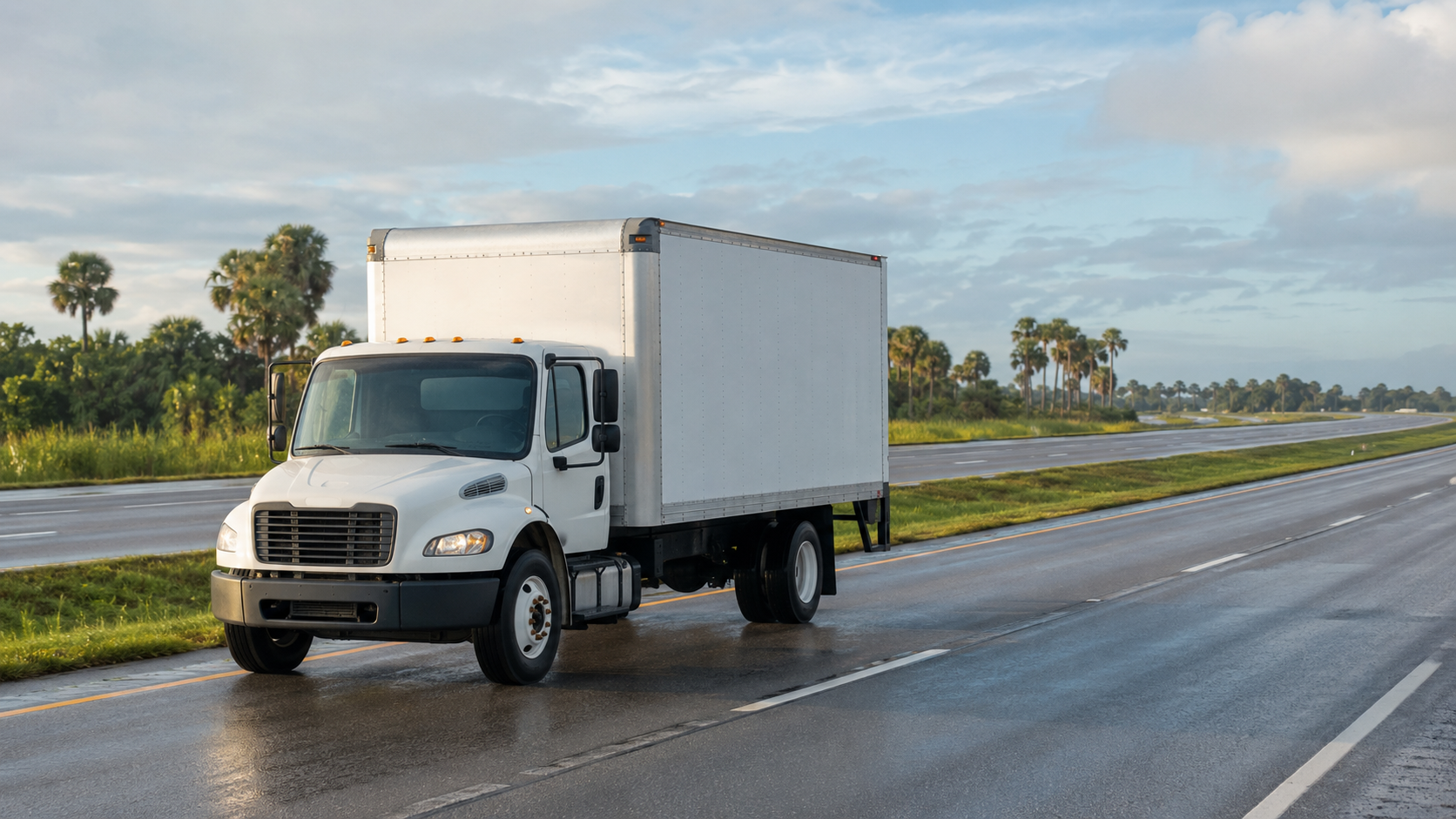
Box trucks are Florida's most common commercial vehicle story: many run under 26,000 pounds, which puts them below the 627.7415 tiers for intrastate work, but for-hire interstate operation still triggers the federal $750,000 minimum above 10,001 pounds. Local final-mile fleets and regional freight operations have very different exposure, and our box truck insurance page covers how those are typically structured.
For general freight, cargo coverage is a market requirement rather than a legal one: $100,000 in motor truck cargo is the standard ask from brokers. Our breakdown of what a $100K cargo policy costs covers the pricing.
How much does truck insurance cost in Florida?
Florida is one of the more expensive states for commercial truck insurance, driven by traffic density, storm exposure, litigation rates, and cargo theft in major corridors. The factors you control are the same ones that matter everywhere: time under authority, driver MVRs, claims history, equipment, radius, and commodities.
We will not invent an average number here, because a Miami reefer fleet and a Panhandle dump truck operation live in different pricing worlds. What we can tell you is what we see across quotes: comparing multiple carriers matters more in Florida than in most states we serve, because insurer appetite for Florida risk varies widely. Details on coverage in the state are on our Florida trucking insurance page.
Frequently Asked Questions
References
- Florida Statutes: 627.7415, Commercial motor vehicles; additional liability insurance coverage
- eCFR: 49 CFR 387.9, Financial responsibility, minimum levels
- Florida Department of Financial Services: Consumer Services
Florida's spread between legal minimums and workable coverage is wide, and so is the spread between insurers. Compare Florida truck insurance quotes from multiple carriers and see where your operation actually prices, filings handled for you.
Continue reading
- Florida trucking insurance requirements
- Compare truck insurance quotes
- Hot Shot Insurance in Abilene TX: Cost and Requirements
- Flatbed Truck Insurance Massachusetts: What It Costs
- Autonomous Truck Insurance Costs After the Beacon Rule: A Cost Drivers Guide
- Coverages we offer for owner-operators & fleets
- Common questions about trucking insurance
Ready to compare rates? Get a free trucking insurance quote from carriers built for trucking regulations.
Ready to Get Started?
Get personalized insurance quotes tailored to your business