Livestock Cargo Insurance: Does It Cover Cattle in Texas?
Get Your Free Insurance Quote
Compare quotes from top carriers in minutes
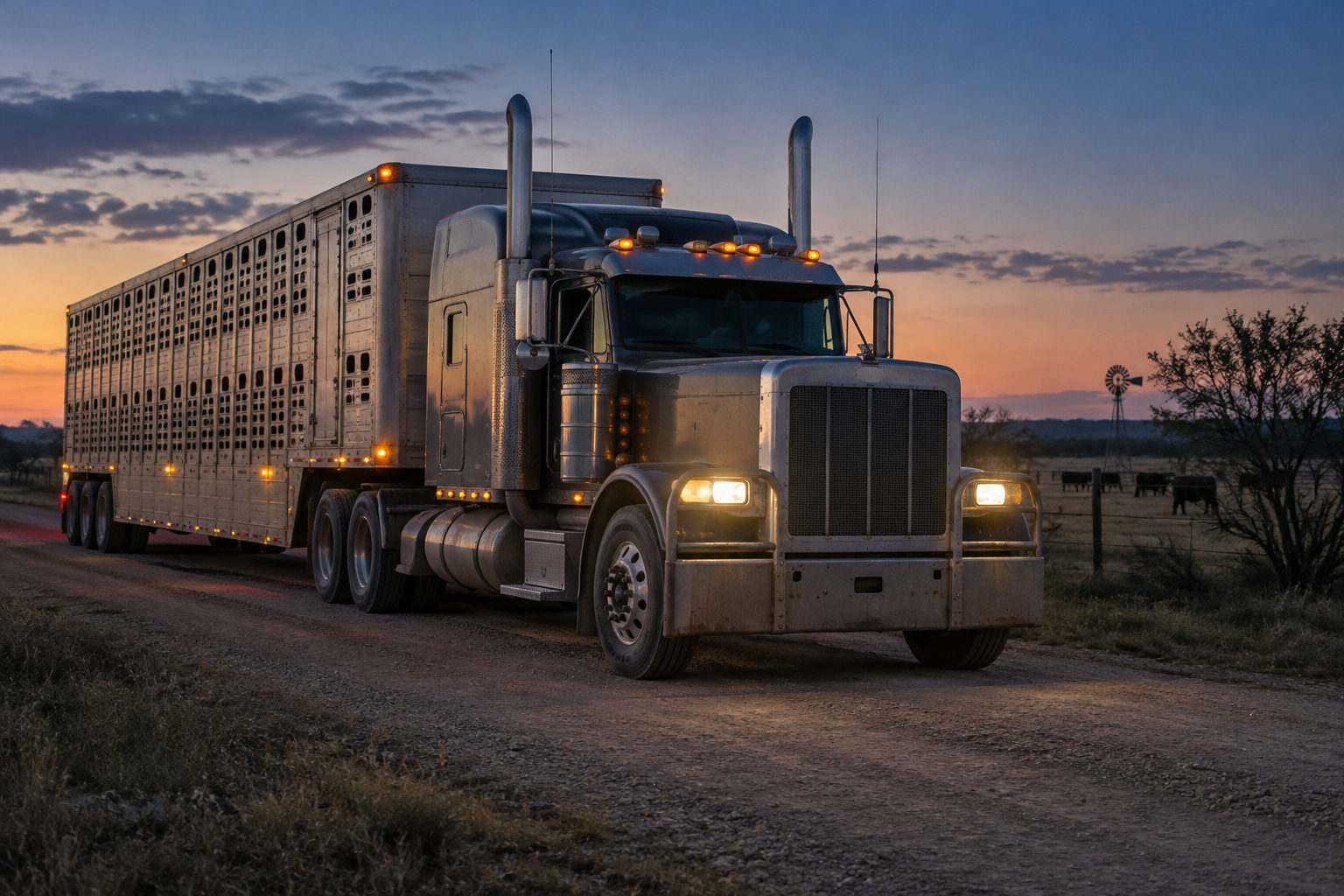
A standard cargo policy may not pay when cattle die on the road. Some motor truck cargo forms exclude loss of or injury to animals unless an accident causes the animal's death or makes it necessary. Livestock cargo insurance, also called livestock transit coverage, is written for live animals and can cover death or crippling while the animals are in transit.
We found no federal or Texas law that requires cargo coverage on livestock loads. Liability insurance is a separate requirement, and it still applies to for-hire haulers whose cattle loads are exempt from federal operating authority. This guide to cattle hauling insurance covers how cargo wording treats cattle, what to check before you load, and what federal and Texas rules ask of hired haulers and ranchers.
Does cargo insurance cover livestock?
Sometimes, and only as far as the wording of your cargo form allows. A motor truck cargo policy is built to pay for loss of or damage to the freight you haul, and each form decides how far that reaches for live animals.
In the policy forms we reviewed, the wording fell into two patterns:
- Death from an accident only. One insurer's motor truck cargo form excludes loss of or injury to animals except against an accident that causes death or makes death necessary. Ask your agent how wording like that handles an injury that doesn't lead to death.
- Livestock written in. A separate livestock coverage form is written around animals rather than freight, with its own causes of loss and its own limits.
The word "cargo" on your declarations page won't tell you which of these you have. The property not covered section and any clause about animals will. Whatever motor truck cargo coverage you carry, ask to see those sections in writing before you take cattle loads.
How is livestock cargo insurance different from a standard cargo policy?
Livestock cargo insurance covers the animals themselves, so it pays for death or crippling of covered livestock rather than damage to freight. The details depend on the insurer and the coverage form.
One livestock transit program we reviewed offers two coverage forms, one with limited causes of loss and one with broad causes of loss. Its application lists these extensions and options:
- substitution of vehicles, carcass removal and refusal of shipment, included
- a per head limit for special value cattle, included, with a higher per head limit available as an option
- deck collapse on multi-level trailers, optional and available only with the limited causes of loss form
- a separate coverage form for other property you haul when you aren't hauling livestock
These options vary by insurer and by policy. The table compares what each type of coverage can include. It doesn't describe any single policy.
| Standard motor truck cargo | Livestock transit coverage | |
|---|---|---|
| Live animals | Can be restricted, for example to death caused by an accident | Written for live animals |
| What it pays for | Loss of or damage to freight | Death or crippling of covered livestock in transit |
| Causes of loss | Named or broad, depending on the form | Limited and broad causes of loss versions exist |
| Upper deck collapse | Not found in the cargo forms we reviewed | Optional in some forms |
| Carcass removal | Not found in the cargo forms we reviewed | Included in some forms |
| Other freight | The core purpose | A separate coverage form in some programs |
A mixed book of loads needs a closer look. In the program above, other freight sits on a separate coverage form, and a general cargo form may not cover your cattle. If you haul both, make sure each kind of load is covered somewhere.
What should you check in your cargo form before you load cattle?
Check the wording that decides whether a dead or injured animal is covered, and do it before the first load rather than after a claim. These questions cover the points where cargo and livestock forms differ most:
- Are live animals or livestock listed as property not covered?
- If animals are covered, is the cover limited to death caused by listed accidents, such as collision or overturn?
- Does the policy cover crippling or injury, or only death?
- Does it use limited (named) causes of loss or broad causes of loss?
- Are loading and unloading covered?
- Is suffocation covered, excluded, or available only as an option?
- Does any cover continue after the cattle are unloaded at the destination?
- If you run a multi-level trailer, is upper deck collapse covered?
- Is the limit set per vehicle, per load or per head, and does it fit the value of the load you carry?
Ask your agent for the policy wording itself, not a summary of it.
Do you need an MC number to haul cattle?
If you haul only ordinary livestock for hire across state lines, you may not need federal operating authority, but you still need liability insurance. Operating authority, liability insurance and cargo insurance are separate requirements, and the livestock exemption affects only the first. It also does not excuse you from a USDOT number or federal safety rules, such as hours of service, driver qualification and vehicle inspection, unless a separate exemption applies.
Operating authority. FMCSA lists for-hire carriers that exclusively haul exempt commodities among the carriers that don't need operating authority (an MC number). Its exempt commodity list, Administrative Ruling 119, includes ordinary livestock.
Liability insurance. FMCSA says carriers hauling exempt commodities must still keep proof of financial responsibility on Form MCS-90. Federal rules require that proof to be kept at the carrier's principal place of business. For for-hire general freight in interstate commerce, in vehicles with a GVWR of 10,001 pounds or more, the federal primary liability insurance minimum is $750,000 under 49 CFR Part 387.
Cargo insurance. FMCSA says household goods carriers and household goods freight forwarders are required to carry cargo insurance. We found no federal requirement for cargo insurance on livestock loads.
Here's how the federal and Texas requirements line up.
| Requirement | For-hire, ordinary livestock only, interstate | Texas intrastate, over 26,000 pounds |
|---|---|---|
| Operating authority | Not required if you exclusively haul exempt commodities | A TxDMV number (Texas intrastate operating authority) is required, unless an exclusion such as the farm vehicle rule applies |
| Liability minimum | $750,000 for general freight at a GVWR of 10,001 pounds or more | $500,000 for most private and for-hire carriers |
| Proof of insurance | Form MCS-90, kept at your principal place of business | Filed by your insurer on Form E |
| Cargo insurance minimum | None found for livestock | None found outside household goods |
What counts as ordinary livestock matters. Ruling 119 describes ordinary livestock as cattle, swine, sheep, goats, horses and mules, except animals chiefly valuable for breeding, racing, show purposes or other special uses. It treats registered or purebred cattle kept for ordinary farm or ranch use as exempt, and it lists rodeo animals as not exempt. Ruling 119 also lists race horses and show horses as not exempt. If you haul seedstock, show cattle or rodeo stock for hire, you may need operating authority for those loads.
Confirm with FMCSA or your state department of insurance before you rely on the exemption for any load.
What insurance do you need to haul livestock in Texas?
For-hire haulers running trucks over 26,000 pounds within Texas need TxDMV registration and liability insurance filed with TxDMV, and Texas doesn't set a cargo insurance minimum for livestock. Carriers operating only in interstate commerce don't register with TxDMV, but they must meet the federal requirements. TxDMV requires motor carrier registration for intrastate operations with a commercial motor vehicle, or combination of vehicles, whose gross weight, registered weight or gross weight rating exceeds 26,000 pounds. The rule covers private carriers as well as for-hire carriers, unless an exclusion such as the farm vehicle rule applies.
For private or for-hire carriers over 26,000 pounds, TxDMV's minimum liability limit is $500,000 for most commodities. Higher limits apply to some hazardous materials, and the limit covers liability to others, not the cargo. Your insurer files proof on Form E, and TxDMV states that only your insurance company can file proof of insurance or cancellation. The only cargo minimum TxDMV lists is for household goods carriers. We found no Texas cargo requirement for livestock hauling insurance.
The farm vehicle exclusion in the next section is limited to vehicles not used in the operation of a for-hire motor carrier.
For the wider set of state rules, see our guide to Texas commercial truck insurance requirements. Confirm your filing and limits with TxDMV or the Texas Department of Insurance.
Do the rules change if you haul your own cattle?
They can, if you're a rancher hauling your own cattle in a lighter rig close to home. TxDMV's rules don't count a farm vehicle with a gross weight, registered weight, or gross weight rating of less than 48,000 pounds as a commercial motor vehicle for registration. Under 43 TAC 218.2, a farm vehicle is one that is:
- controlled and operated by a farmer to haul agricultural products, or farm machinery or supplies, to and from a farm
- not used in the operation of a for-hire motor carrier
- not carrying hazardous materials that require placards
- used within 150 air-miles of the farmer's farm
TxDMV requires registration for a farm vehicle with a gross weight, registered weight or gross weight rating of 48,000 pounds or more. On the federal side, the property carrier minimums in 49 CFR Part 387 are written for for-hire carriers, with separate provisions for certain hazardous materials.
None of this tells you whether your cattle are insured on the road. Read your farm or ranch policy to see whether it covers livestock in transit, and on what terms. Because the farm vehicle definition excludes vehicles used in the operation of a for-hire motor carrier, talk to TxDMV before you haul other people's cattle for pay. Confirm how these rules apply to your operation with FMCSA or TxDMV.
Read the form before you load
Whether your cattle are covered depends on the wording of your cargo or livestock form, not on the word "cargo" in your policy. The livestock exemption can remove the need for operating authority on qualifying loads, but it doesn't remove the need for liability insurance, and it doesn't insure the animals. Get the wording in writing and check it against the questions above before you haul.
If you're an owner-operator setting up your insurance, a brokerage such as Trucker Path Insurance compares quotes from multiple carriers. Compare commercial truck insurance quotes for primary liability, motor truck cargo and physical damage before your next load.
Frequently Asked Questions
Continue reading
- Texas trucking insurance requirements
- Compare truck insurance quotes
- Commercial Trucking Insurance in Oklahoma City: Cost Guide
- Tractor Trailer Insurance in Decatur GA: 2026 Cost and Coverage
- Texas Dump Truck Insurance: State vs Contractor Rules
- Coverages we offer for owner-operators & fleets
- Common questions about trucking insurance
Ready to compare rates? Get a free trucking insurance quote from carriers built for insurance tips.
Ready to Get Started?
Get personalized insurance quotes tailored to your business