Truck Insurance in Chicago: Why Garaging Address Matters
Get Your Free Insurance Quote
Compare quotes from top carriers in minutes
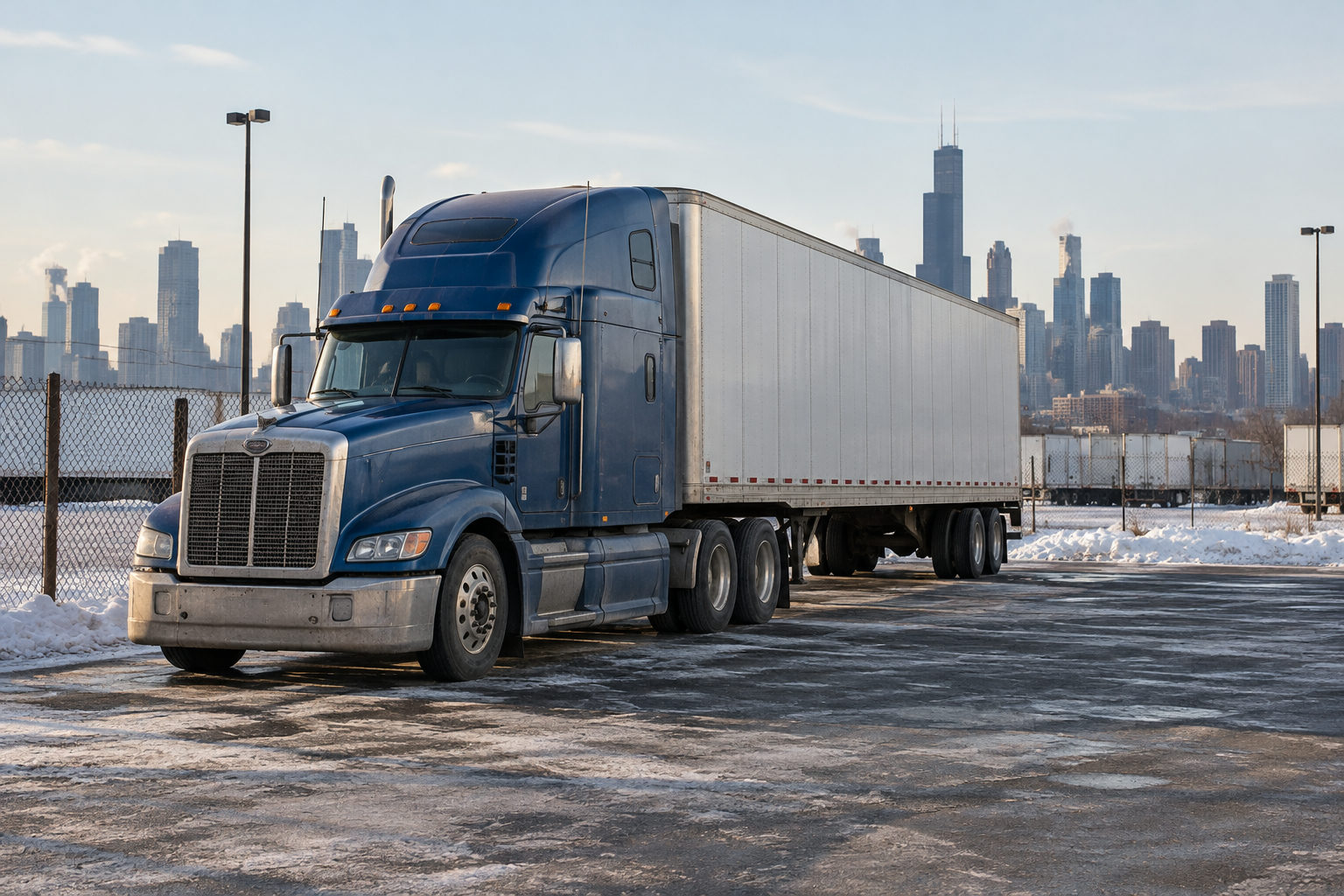
Truck insurance in Chicago starts with one line on your application: the address where the truck is principally garaged. In the published commercial auto manual we reviewed, that street address sets the rating territory for trucks that aren't zone rated, and territory pricing reflects the losses expected at a location. A Chicago-garaged truck is rated in whatever territory its insurer uses for that address.
Illinois adds two rules of its own. Commercial auto rates don't have to be filed with the state, and we found no public table that shows a Chicago factor for trucks. For bodily injury liability, insurers also can't split Chicago into separate rating districts.
Below, we cover how garaging drives rating, what public data shows about operating out of Chicago, and the parts you control.
What is a garaging address, and why does it matter for truck insurance?
Your garaging address is the street address where your truck is principally kept when it isn't working. It matters because rating starts there.
One public example is the CAR Commercial Automobile Insurance Manual, effective March 1, 2026, published by Commonwealth Automobile Reinsurers for Massachusetts. For trucks that aren't zone rated, it states that "rating territory is determined based upon the street address of principal garaging." It also measures a truck's radius class in a straight line from that address:
- Local: not operated beyond 50 miles from the garaging address
- Intermediate: operated beyond 50 miles but not beyond 200 miles
- Long distance: operated beyond 200 miles
The manual doesn't simply go by the longest trip. It uses the longest radius class unless 80% or more of the truck's operation is in a single shorter class. Trucks regularly operated beyond 200 miles from the garaging address are zone rated instead.
These bands come from one state's manual and are shown as an example only. Illinois doesn't require commercial auto rates and rules to be filed, so the rules behind Illinois truck quotes aren't public and may work differently.
Verisk, a data analytics and technology partner to the insurance industry, describes address-level territory rating that models local conditions to estimate expected loss cost. It also notes that "garaging misclassification can often impact loss cost relativity." In plain terms, a wrong address can put a truck in the wrong rating territory.
How do insurers rate a truck garaged in Chicago?
A Chicago garaging address feeds into how an insurer rates the truck, under rates and rules Illinois doesn't require insurers to file. State law shapes that process in three ways.
| Illinois rule | What it says | What it doesn't address |
|---|---|---|
| 215 ILCS 5/155.17 | Insurers writing motor vehicle bodily injury coverage can't base those rates on divisions or districts within a municipality of 2,000,000 or more people. The Illinois Department of Insurance says this applies only to Chicago. | Physical damage, cargo, and addresses outside the city |
| IDOI commercial auto filing checklist | Commercial auto rates and rules are not required to be filed in Illinois. Taxicab rates are the exception the checklist lists. | How any insurer draws its territories |
| 215 ILCS 5/155.22 | An insurer can't refuse coverage based solely on the specific geographic location of the risk, unless the refusal is for a business purpose that isn't a pretext for unfair discrimination. | How a location is priced |
Two things follow for a Chicago operator.
First, the bodily injury rule is narrow. According to the Illinois Department of Insurance, "the base rate for bodily injury liability must be the same for all territories within a city" of 2,000,000 or more people, which it says applies only to Chicago. The statute doesn't address physical damage, cargo or addresses outside the city.
Second, because commercial auto rates aren't filed, we found no public source showing how much a Chicago or Cook County address changes a truck premium. A quote is the only reliable way to see how a given insurer treats your address.
This is a summary of the statutes, not legal advice. Confirm how they apply to your policy with your agent or the Illinois Department of Insurance.
What's different about running trucks out of Chicago?
Chicago combines a top-ranked freight bottleneck, a county named among cargo theft concentrations and a truck parking shortage flagged in federal surveys. Cook County, which includes Chicago, also accounts for more than half of Illinois's reported crashes. These are conditions in the area, not line items on a quote. No public source shows how much any one of them adds to a truck's premium.
| Condition | What public data shows | Source and date |
|---|---|---|
| Congestion | I-294 at I-290/I-88 in Chicago ranked as the top freight bottleneck in the country | ATRI, list published February 2026, using 2025 data |
| Cargo theft | Illinois had 40 reported incidents in the quarter, down from 52, and Cook County was named among the county concentrations | Verisk CargoNet, July through September 2026 |
| Truck parking | The Chicago area was listed among areas of truck parking shortage, as it was in 2014 | FHWA Jason's Law results, 2019 survey, presented December 2020 |
| Crash counts | Cook County had 164,559 of the 303,913 crashes reported in Illinois, all vehicle types | IDOT, 2024 |
ATRI's ranking measures truck-involved congestion using truck GPS data. ATRI publishes the list every year and the order can change, so read it as a snapshot of the corridor.
CargoNet's figures count reported cargo theft and supply chain crime. In the same quarter, it said fictitious pickups made up roughly one in four reported incidents.
FHWA presented its 2019 Jason's Law survey results in December 2020, and as of November 2026 its truck parking page still lists them as the latest. Drivers reported parking problems in every state, particularly along I-95, in the Chicago region and on I-5 in California. New shortages had also emerged in the states around the Chicago region.
Crash counts cover all of Cook County, not just the city of Chicago, and include every vehicle type. They're counts rather than rates, so they don't show that any one truck is riskier.
Our page on Illinois truck insurance requirements covers the state's own filing rules, plus drayage around the rail yards and winter driving on the northern corridors.
Can you list a different garaging address to lower your rate?
No. The garaging address on your application should be where the truck is actually kept. Illinois law has rules on misrepresentation and cancellation, but which ones apply depends on the coverage and the policy.
215 ILCS 5/154 deals with misrepresentations made when buying a policy. A misrepresentation can defeat a policy under this section if it was made with actual intent to deceive, or if it "materially affects either the acceptance of the risk or the hazard assumed by the company." It must be stated in the policy, an endorsement or rider attached to it, or the written application. The section also says it doesn't apply to marine or transportation insurance, so it may not reach every coverage on a truck policy, such as cargo. Ask your agent which parts of your policy it covers.
215 ILCS 5/143.16a is a separate rule. It limits when certain policies can be cancelled once they've been in effect for 60 days, and the Illinois Department of Insurance lists it in its commercial auto checklist. The reasons it allows include that "the policy was obtained through a material misrepresentation" and that the risk originally accepted has measurably increased. Whether it covers your policy depends on the policy type, so check with your agent.
Neither section mentions garaging addresses specifically, and whether a wrong address falls under either one depends on the facts. The safer move is to report the yard where the truck actually sleeps and update it when that changes.
What about a yard in the suburbs? The Chicago bodily injury rule covers divisions within the city. How a suburban address rates is up to each insurer. If you genuinely move your truck to a suburban yard, tell your agent and compare quotes on the new address.
This is general information, not legal advice. Check the details with your agent or the Illinois Department of Insurance.
What can a Chicago operator control?
You can't change how an insurer rates Chicago. You do control the accuracy of what you report and how exposed your truck and freight are.
- Keep your garaging and radius details accurate. Give the street address where the truck is principally kept, and an honest picture of how far it runs from there.
- Tell your agent when the yard changes. A move across town or out to the suburbs is the kind of change your insurer needs to hear about.
- Plan overnight parking before you need it. Federal surveys have listed the Chicago area among parking shortage areas, so line up a regular spot rather than hunting late at night.
- Choose secure yards. Pick lit, fenced and monitored parking where you can.
- Verify every pickup. With fictitious pickups making up about one in four reported cargo theft incidents, confirm the carrier and driver before freight leaves your control.
- Compare quotes. With no filed rates to go by, a quote is the only way to see how different insurers price the same Chicago address.
Know which coverage you're buying for each risk. Our overview of the coverages we offer explains physical damage and motor truck cargo. Our trucking liability insurance page covers the bodily injury side. For general ways to bring premiums down, see our guide to ways to lower your truck insurance cost.
Frequently Asked Questions
Get Quotes Built on Where Your Truck Really Parks
Your garaging address feeds into how your truck is rated, and there's no public Chicago rate that applies to every insurer. Trucker Path Insurance is a brokerage that compares quotes from multiple carriers, so you can see how different insurers treat the address where your truck actually sleeps. Compare truck insurance quotes.
Continue reading
- Commercial truck insurance
- Compare truck insurance quotes
- Hail Damage to Trucks in Colorado: What Your Policy Covers
- Colorado Towing Permit: PUC Insurance Filings You Need
- Florida Tow Truck Insurance Requirements for FHP Rotation
- Coverages we offer for owner-operators & fleets
- Common questions about trucking insurance
Ready to compare rates? Get a free trucking insurance quote from carriers built for insurance tips.
Ready to Get Started?
Get personalized insurance quotes tailored to your business