UIIA Insurance Requirements for Chicago Intermodal Drayage
Get Your Free Insurance Quote
Compare quotes from top carriers in minutes
UIIA insurance requirements start with two fixed coverages: a commercial auto liability policy with a $1 million combined single limit and the UIIA intermodal endorsement attached, and general liability of $1 million per occurrence with no self-insured portion. On top of that, each equipment provider you pull for sets its own requirements for trailer interchange, cargo and, in some cases, workers' compensation. Your insurance agent submits one certificate of insurance to the UIIA online, and every equipment provider you work with must be listed as an additional insured on your auto liability policy.
The UIIA, or Uniform Intermodal Interchange and Facilities Access Agreement, is the standard contract between intermodal trucking companies and the railroads, ocean carriers and leasing companies that supply containers and chassis. The Intermodal Association of North America (IANA) runs it. Chicago adds two layers to that. All six Class I freight railroads converge here, and the region has 18 active intermodal terminals, each serving its own set of destinations, so a Chicago drayage carrier can end up meeting the rules of several equipment providers at once. Loads that stay inside Illinois also bring Illinois's own registration and insurance filing rules.
What insurance does the UIIA require?
The UIIA itself requires auto liability and general liability. Each equipment provider adds its own trailer interchange, cargo and workers' compensation terms.
| Coverage | Requirement | Who sets it |
|---|---|---|
| Commercial auto liability | $1 million combined single limit, primary, with the UIIA endorsement (UIIE-1, CA 23 17 or TE 23 17B, most current version). The policy must be marked Any Auto, Scheduled and Hired, or All Owned and Hired. | UIIA agreement |
| General liability | $1 million per occurrence, with no portion self-insured | UIIA agreement |
| Trailer interchange | Must cover comprehensive and collision, plus fire and theft. Limits and deductibles vary. | Each equipment provider |
| Motor truck cargo | Required by the majority of equipment providers. Limits and deductibles vary. | Each equipment provider |
| Workers' compensation and employer's liability | Required by some equipment providers, with statutory limits for workers' compensation | Each equipment provider |
IANA states that an "All Owned" or "Scheduled Only" auto policy is not acceptable. If you're self-insured, IANA asks you to contact the UIIA office first.
The $1 million auto limit is higher than the federal floor. FMCSA's filing table lists $750,000 for for-hire carriers of general freight in interstate commerce with a GVWR of 10,001 pounds or more. Confirm your filings with FMCSA or your state department of insurance, and see our trucking liability insurance page for how auto liability limits work.
Why does the UIIA require a special auto endorsement?
Because the agreement makes you responsible for equipment providers' losses tied to your use of their equipment, and the endorsement extends your auto policy to cover that promise.
Section F.4 of the UIIA is an indemnity clause. In it, the motor carrier agrees to "defend, hold harmless and fully" indemnify the provider, subject to listed exceptions. The UIIE-1 endorsement applies your auto liability coverage to "liability assumed by the named insured, as 'Motor Carrier Participant,' under Subsection F.4" of the agreement.
The agreement also says its insurance minimums "do not in any way limit the Motor Carrier's liability under this Agreement." The $1 million figure is what you must carry, not a cap on what you could owe. Ask your agent to confirm the endorsement on your policy is the current version.
What is UIIA trailer interchange coverage, and how much do I need?
Trailer interchange covers physical damage to equipment you don't own, such as containers and chassis, while it's in your care, custody or control. How much you need depends on the equipment providers you pull for.
IANA requires trailer interchange to cover comprehensive and collision as well as fire and theft. Limits and deductibles are set by each equipment provider in its rules (UIIA Form 5B), and most providers require some form of it. Your policy has to meet the requirements of every provider you plan to work with, so check each one's rules before you set your limit.
Trailer interchange is separate from two other coverages:
- Motor truck cargo covers the freight inside the container, not the container or chassis.
- Physical damage covers your own tractor and any equipment you own.
The coverages we offer page describes each one of these.
How do I get approved to pull containers from Chicago rail yards?
You join the UIIA as a motor carrier, your agent files your insurance online, and each equipment provider then decides whether to approve you for interchange.
- Check your registration. A container move that starts or ends outside Illinois can be interstate or foreign commerce even if your truck stays in the Chicago area. Moves that stay entirely inside Illinois follow the state rules in the next section. Federal rules define interstate commerce to include transportation "between two places in a State as part of trade, traffic, or transportation" that starts or ends outside the state. Confirm your USDOT registration and any operating authority with FMCSA.
- Get a SCAC. UIIA's motor carrier application directs carriers to the National Motor Freight Traffic Association for a Standard Carrier Alpha Code (SCAC), which UIIA uses to identify you.
- Apply for UIIA participation through IANA.
- Have your agent file one certificate. Agents must be registered with the UIIA and submit insurance online on the ACORD 22 certificate, with NAIC numbers for each policy. IANA doesn't need a separate certificate for each equipment provider and no longer accepts mailed copies.
- List your equipment providers. Every UIIA equipment provider you do business with must be an additional insured on your auto liability policy. Agents can use the blanket additional insured boxes on the online form.
- Get each provider's approval. Equipment providers receive your interchange status from the UIIA and pass it to the facilities they use.
The UIIA sets up the interchange contract. It doesn't find you loads.
What Illinois rules apply to Chicago drayage outside the UIIA?
Two sets: Illinois's own registration and insurance filing for loads that stay inside the state, and road permits for overweight container moves.
Intrastate loads. Illinois regulates for-hire trucking that stays inside the state, such as a container move with no leg of its trip outside Illinois, through its Commercial Transportation Law. That law says no motor carrier of property "shall operate within this State unless it has on file with the Commission or its agent proof of continuous insurance or surety coverage." For-hire carriers of property apply to the Illinois Commerce Commission for a certificate to haul in intrastate commerce, and the liability certificate filed with the Commission is Form E. Three points matter for your insurance:
- Your Illinois license or registration has force only while your proof of insurance stays on file with the Commission.
- For Illinois-based carriers and Illinois-licensed intrastate carriers, the coverage must come from an admitted insurance company authorized to write commercial auto insurance in Illinois.
- The Commission sets its liability minimums by reference to federal limits, so ask your agent which limit your Illinois filing needs.
Overweight containers. IDOT issues oversize and overweight permits for highways the state is responsible for. For roads under local control, IDOT says permittees must get permission from the local authorities before the move. Cross-town drayage between terminals can mean more than one road authority on a single trip, so check each one's permit rules.
Confirm intrastate filing questions with the Illinois Commerce Commission, and see our Illinois truck insurance requirements for the state's other rules.
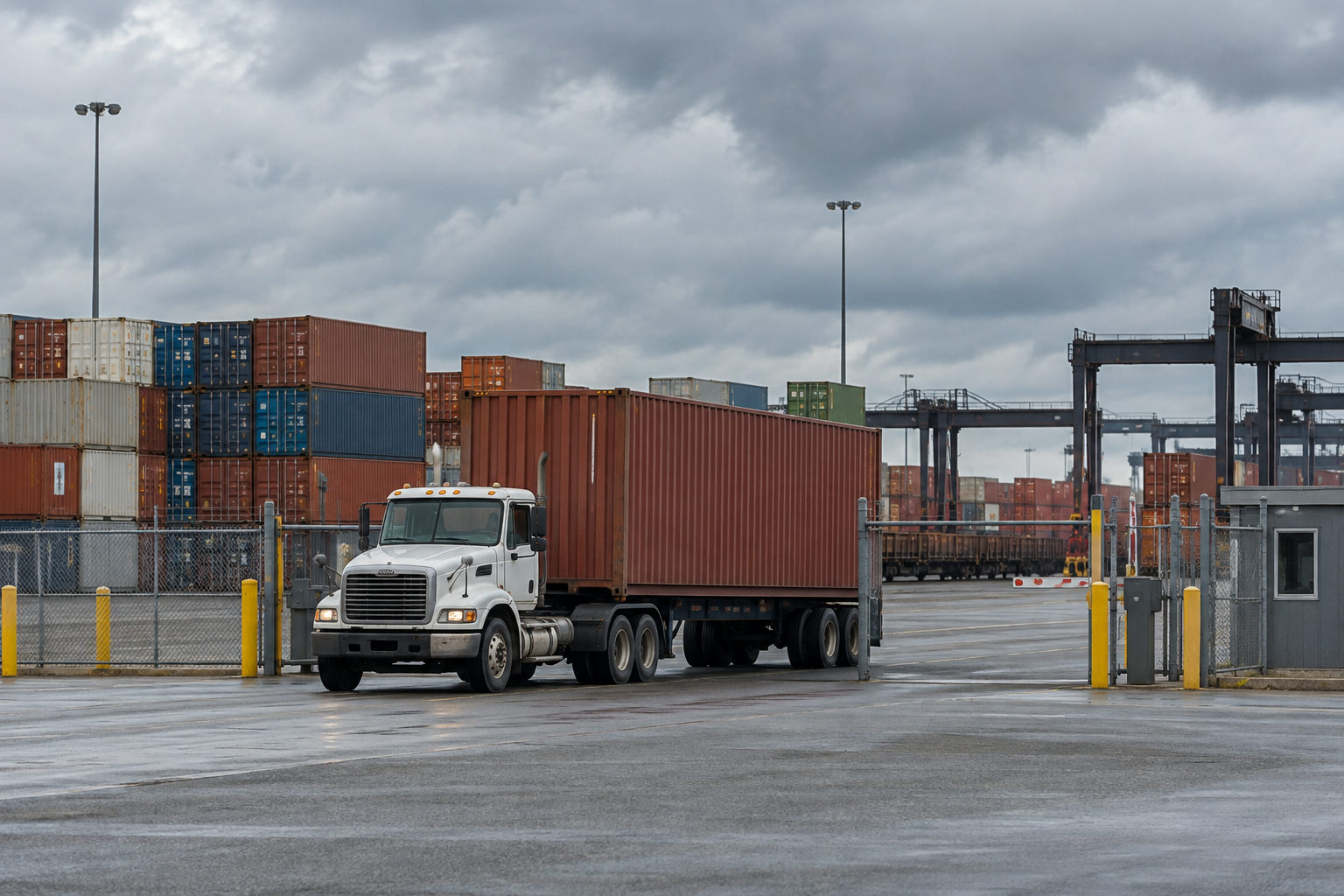
What can stop me at the rail yard gate?
Insurance problems that can block interchange include a policy the UIIA shows as expired or cancelled, and a limit below a provider's requirement.
- Expiration. The UIIA system expires policies at 12:01 a.m. on the expiration date. Your agent needs to submit the renewal before then, with an effective date that matches the old policy's expiration.
- Cancellation notice. The agreement requires at least 30 days' advance notice to IANA before a policy is cancelled, with a shorter period when the cancellation is for nonpayment.
- Exclusions. Exclusionary endorsements should be noted on an ACORD 101 form when the certificate is submitted.
- Provider rules. If your trailer interchange or cargo limit falls below a provider's requirement, that provider's approval can be affected.
- Insurer confirmation. IANA requires policies from some named insurers to be confirmed within 24 hours of the certificate being submitted.
The agreement also lets a provider or facility operator refuse access to a motor carrier for good cause. Check your UIIA account before each renewal, and confirm questions about your filings with IANA or your agent.
Frequently Asked Questions
Where can I compare quotes for intermodal work?
Trucker Path Insurance is a brokerage that compares quotes from multiple carriers. Get a truck insurance quote and tell us which equipment providers you plan to pull for and the limits they require, so the quotes you compare are built around them.
Continue reading
- Commercial truck insurance
- Compare truck insurance quotes
- Hail Damage to Trucks in Colorado: What Your Policy Covers
- Colorado Towing Permit: PUC Insurance Filings You Need
- Florida Tow Truck Insurance Requirements for FHP Rotation
- Coverages we offer for owner-operators & fleets
- Common questions about trucking insurance
Ready to compare rates? Get a free trucking insurance quote from carriers built for insurance tips.
Ready to Get Started?
Get personalized insurance quotes tailored to your business