Texas Hotshot Insurance: In-State vs Interstate Rules
Get Your Free Insurance Quote
Compare quotes from top carriers in minutes
Texas hotshot insurance requirements depend on four things: what your truck and trailer weigh, whether you haul for hire, what you haul, and whether the freight's trip leaves Texas. On a Texas-only run, state motor carrier rules start when your rig's gross weight, registered weight or gross weight rating goes over 26,000 pounds, or when you haul hazardous materials in a quantity that requires placards. For general freight over 26,000 pounds, you need a TxDMV number and a $500,000 liability minimum, filed with TxDMV by your insurer. Placarded hazmat needs a TxDMV number at any weight, and TxDMV sets separate, higher limits for some hazardous cargo, such as $1,000,000 for listed oil and $5,000,000 for listed hazardous substances. Federal rules start lower. Once a load is in interstate commerce and your truck and trailer reach 10,001 pounds, you need a USDOT number, and for-hire carriers generally also need federal operating authority with a liability filing of $300,000 or $750,000.
The sections below map each common setup. For the policies behind these requirements, see our hotshot insurance page.
Which weight lines matter for a Texas hotshot?
Three weight lines matter: 10,001 pounds for federal rules, more than 26,000 pounds for Texas rules, and 26,001 pounds of combined weight for a Class A CDL. Each one is measured a different way.
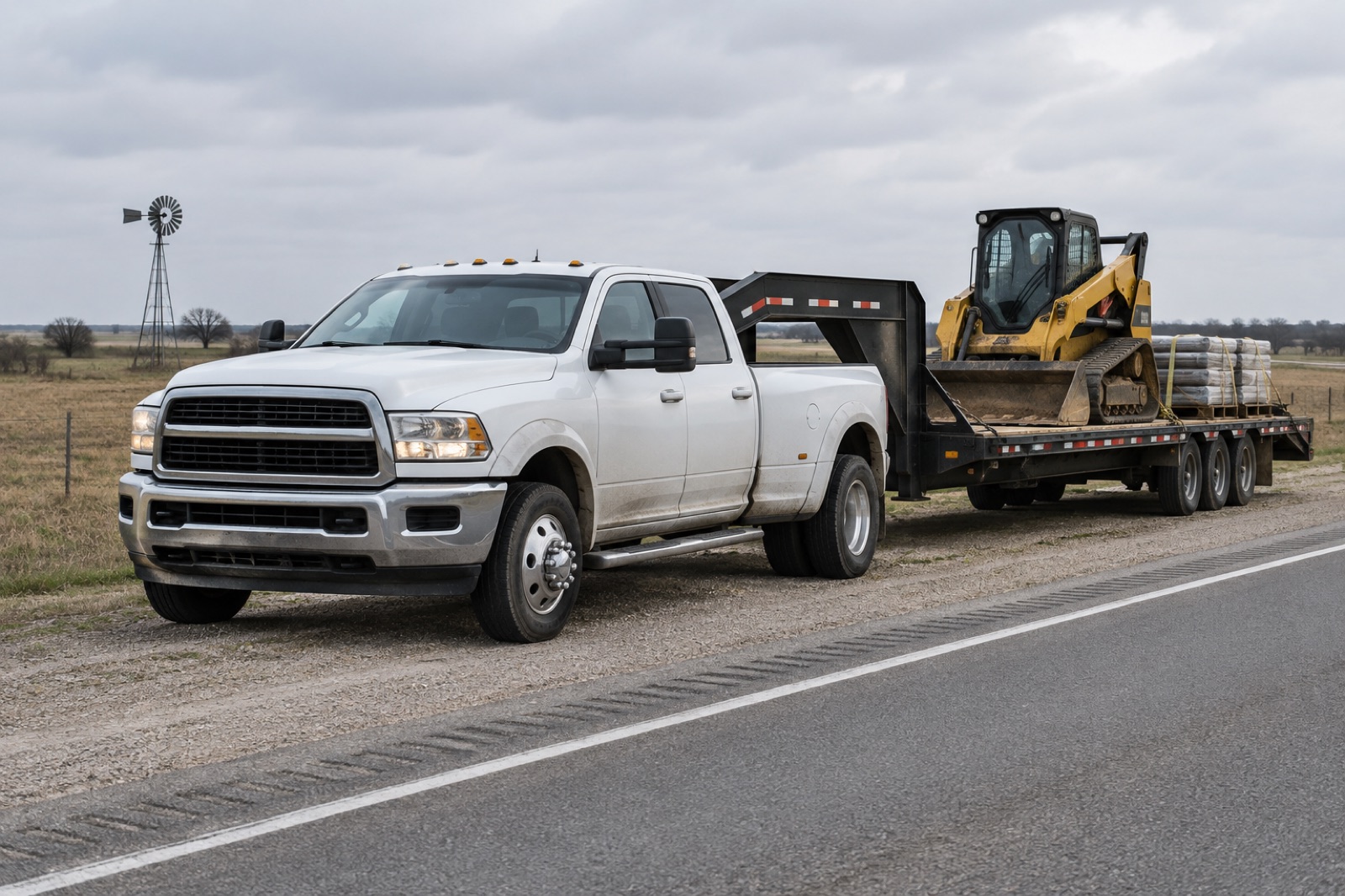
Federal rules start at 10,001 pounds. In interstate commerce, a truck or truck and trailer is a commercial motor vehicle at a weight rating or actual weight of 10,001 pounds or more, whichever is greater. The truck and trailer count together. FMCSA guidance says that if the GVWR of the truck added to the GVWR of the trailer exceeds 10,001 pounds, the driver and vehicle are subject to the federal safety rules. A pickup and a gooseneck that are each rated under 10,001 pounds can cross that line once they're hitched.
For Texas rules, the line is more than 26,000 pounds. TxDMV's rule looks at gross weight, registered weight or gross weight rating.
A Class A CDL follows its own test. The Texas Department of Public Safety lists Class A for a combination with a gross combination weight rating of 26,001 pounds or more when the towed vehicle is rated over 10,000 pounds. Federal CDL rules count the rating or the actual weight, whichever is greater, so loaded weight can trigger a CDL. Hazmat is its own case: under those same rules, a vehicle "of any size" hauling placarded hazardous materials counts as a commercial motor vehicle.
| Weight line | How it's measured | What it triggers |
|---|---|---|
| 10,001 pounds or more (federal) | Weight rating or actual weight, whichever is greater; truck and trailer ratings added together | Federal safety rules and a USDOT number on interstate loads, plus operating authority and a federal filing for for-hire carriers |
| More than 26,000 pounds (Texas) | Gross weight, registered weight or gross weight rating | TxDMV number and a $500,000 liability minimum on Texas-only loads |
| 26,001 pounds or more combined, towed unit over 10,000 pounds | Rating or actual weight, whichever is greater | Class A CDL |
| Placarded hazardous materials | Any weight | CDL, TxDMV number, and higher insurance limits for some cargo |
Confirm your setup with FMCSA, TxDMV or the Texas Department of Insurance.
What does a Texas-only (intrastate) hotshot need?
Once your rig is over 26,000 pounds or hauls placarded hazmat, a Texas-only hotshot needs a USDOT number, a TxDMV number and liability insurance on file with TxDMV. That applies whether you haul for hire or haul your own equipment.
- Get a USDOT number first. TxDMV requires a valid USDOT number before you apply. If you run only inside Texas, register with USDOT as intrastate, not interstate.
- Apply for a TxDMV number through TxDMV's motor carrier credentialing system, TxMCCS.
- Carry the minimum limit. TxDMV's minimum for private or for-hire carriers over 26,000 pounds is $500,000. Some cargo needs more: $1,000,000 for oil listed in 49 CFR 172.101, and $5,000,000 for hazardous substances as defined in 49 CFR 171.8. The full table is on TxDMV's TxDMV number requirements page.
- Have your insurer file Form E. TxDMV states that only your insurance company can file proof of insurance or cancellation.
Cargo insurance is a separate question. TxDMV's cargo insurance requirement applies to household goods carriers, and we found no Texas cargo insurance requirement for general freight hotshots.
At 26,000 pounds or under with no hazmat, we found no TxDMV registration or Form E requirement for a general freight hotshot. Ask your agent or the Texas Department of Insurance which liability limits apply to your truck. For how Texas filings and cab cards work, see our Texas commercial truck insurance requirements. Confirm your setup with TxDMV or the Texas Department of Insurance.
When does a Texas-only load count as interstate?
A load can count as interstate commerce even if your truck never leaves Texas. Federal rules define interstate commerce to include transportation "between two places in a State as part of trade, traffic, or transportation" that starts or ends outside the state (49 CFR 390.5).
FMCSA's guidance says the test is the essential character of the movement, shown by "the shipper's fixed and persistent intent at the time of shipment." Before you treat a Dallas to Houston load as intrastate, ask the shipper or broker where the freight started and where it ends up. If either point is outside Texas, read FMCSA's guidance on interstate and intrastate commerce and confirm with FMCSA.
What changes when you start crossing state lines?
Once you run interstate at 10,001 pounds or more, federal registration applies, and for-hire carriers also need operating authority with an insurance filing.
- USDOT number. FMCSA requires interstate commercial motor vehicles to be registered and to have a USDOT number, whether you haul for hire or haul your own equipment. If yours is registered as intrastate, ask FMCSA how to update it before your first interstate load.
- Operating authority and a federal filing (for-hire). Once you apply for operating authority, your insurer files proof of liability with FMCSA on Form BMC-91 or BMC-91X. FMCSA's filing table lists $750,000 for vehicles with a GVWR of 10,001 pounds or more and $300,000 under 10,001 pounds for general freight. If your pickup alone is rated under 10,001 pounds but the truck and trailer together are rated higher, ask your agent which tier your filing needs.
- UCR. A Texas rule requires interstate motor carriers and private carriers of property operating in Texas to register under the Unified Carrier Registration system. TxDMV says UCR fees are paid every year.
- MCS-150. TxDMV notes that to keep your USDOT number active, you update Form MCS-150 with FMCSA every two years.
- IRP apportioned plates. TxDMV's IRP packet requires apportioned registration for a power unit used in two or more jurisdictions that has two axles and a gross or registered weight over 26,000 pounds, has three or more axles regardless of weight, or runs in a combination whose gross vehicle weight exceeds 26,000 pounds. Below those lines, apportioned registration is optional. See the TxIRP information packet.
- IFTA fuel tax license. IFTA covers a vehicle with two axles and a gross or registered weight over 26,000 pounds, a vehicle with three or more axles regardless of weight, or a combination over 26,000 pounds. The Texas Comptroller says a pickup that occasionally pulls a trailer and goes over 26,000 pounds counts. See the Comptroller's IFTA FAQ.
Here's how the common setups compare.
| Setup | Texas only | Crossing state lines |
|---|---|---|
| 26,000 pounds or under, no hazmat | We found no TxDMV registration or Form E requirement; ask your agent which liability limits apply | At 10,001 pounds or more: USDOT number and UCR; for-hire adds authority and a $300,000 or $750,000 filing. A two-axle truck: IRP optional, no IFTA. Three or more axles: both. |
| Over 26,000 pounds, for-hire | USDOT number (intrastate), TxDMV number, $500,000 minimum, Form E | USDOT number (interstate), operating authority and federal filing, UCR, IRP, IFTA |
| Over 26,000 pounds, hauling your own equipment | USDOT number (intrastate), TxDMV number, $500,000 minimum, Form E | USDOT number, UCR, IRP, IFTA (387.3(a) minimums are written for for-hire carriers) |
| Placarded hazmat, any weight | CDL, TxDMV number, higher limits for some cargo | CDL, federal hazmat limits under 387.3(b), plus the interstate items above |
| Leased onto a carrier | Ask the carrier which registration and filings it provides | Federal leasing rules require the lease to state the carrier's obligation to maintain public liability insurance |
Confirm your registration and filings with FMCSA or your state department of insurance before your first interstate load.
What's legally required vs what brokers and lenders ask for?
Everything above is a legal requirement. Brokers, shippers and lenders set their own insurance terms in their contracts, and those can ask for more.
- Brokers and shippers. Ask each broker for its insurance requirements in writing before you book, including liability limits and any cargo coverage.
- Lenders. If your truck or trailer is financed, read the loan or lease agreement for its insurance terms, which may include physical damage coverage.
- Leased-on operators. Federal leasing rules require the lease to clearly specify the carrier's legal obligation to maintain insurance for the protection of the public. Ask the carrier, in writing, which coverages it provides and which the lease expects you to carry yourself, and confirm lease questions with FMCSA.
For limits above the minimum, see trucking liability insurance, and for policy types you can add, see the coverages we offer.
Frequently Asked Questions
Continue reading
- Hotshot truck insurance
- Texas trucking insurance requirements
- Compare truck insurance quotes
- Colorado Towing Permit: PUC Insurance Filings You Need
- Florida Tow Truck Insurance Requirements for FHP Rotation
- Hail Damage to Trucks in Colorado: What Your Policy Covers
- Coverages we offer for owner-operators & fleets
- Common questions about trucking insurance
Ready to compare rates? Get a free trucking insurance quote from carriers built for trucking regulations.
Ready to Get Started?
Get personalized insurance quotes tailored to your business