Logging Truck Insurance Cost in Florida: What You'll Pay
Get Your Free Insurance Quote
Compare quotes from top carriers in minutes
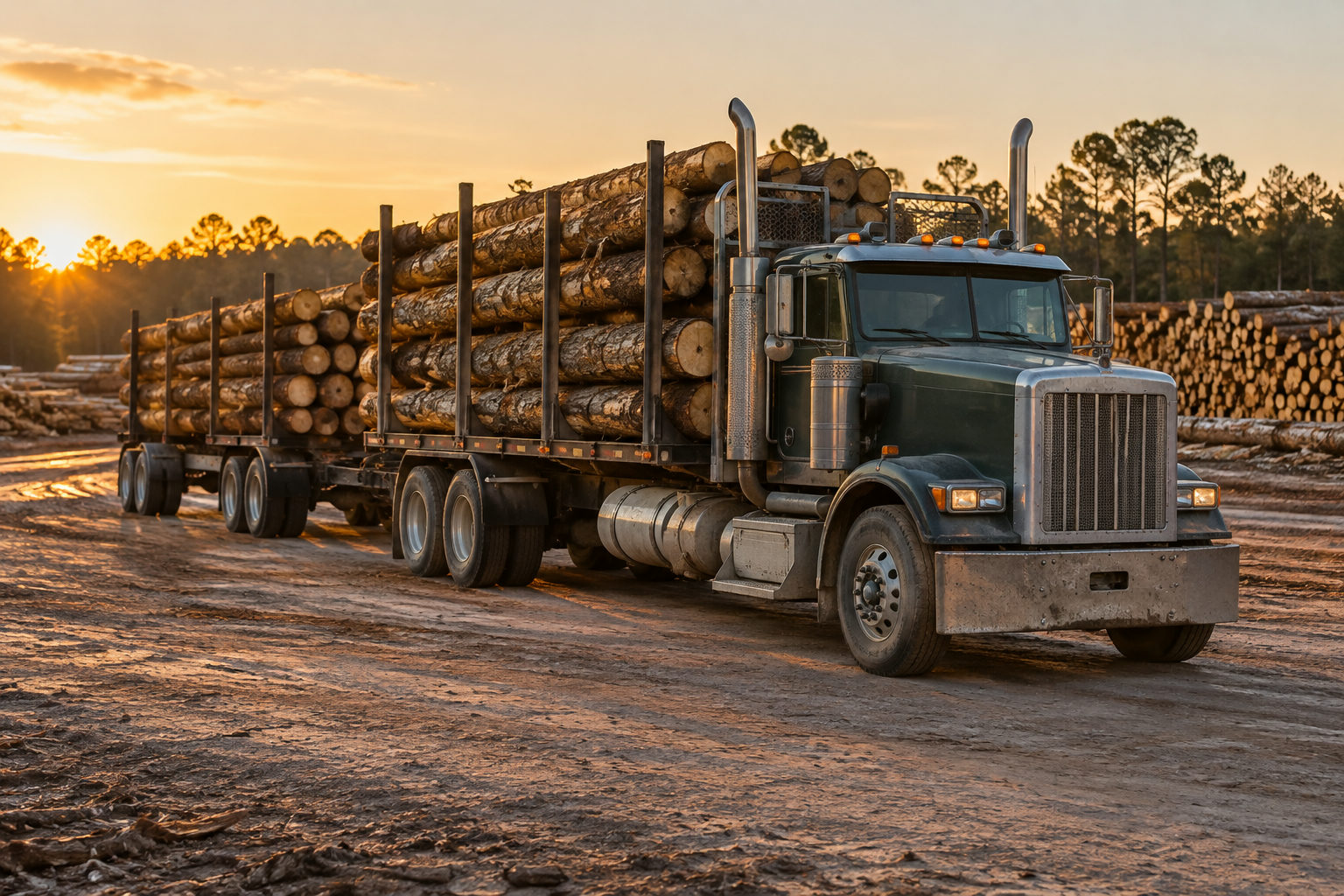
A full logging truck insurance policy in Florida usually bundles four coverage types: primary liability, motor truck cargo, physical damage, and occupational accident coverage for the driver. Together they typically cost more than standard dry van or box truck coverage because of rollover risk, off-road driving, and the value of the timber being hauled. As of October 2026, owner-operators running a single logging truck with a pole trailer can expect primary liability premiums somewhere in the range of $9,000 to $18,000 a year, as a rough estimate. Full coverage packages bundling liability and physical damage for Florida log trucks typically run between $9,500 and $17,000 per year when a carrier applies a multi-line discount, according to Bridgeway Insurance Services (current as of March 2026). That bundled figure doesn't include general liability or occupational accident coverage, which carriers usually price and quote as separate line items, which is why adding every coverage line individually can land higher than the quoted package price. For broader context on how commercial auto costs vary by vehicle type, radius, and loss history, see the Insurance Information Institute's overview of commercial auto insurance. Those are estimates, not a quote, and your actual number depends on the specifics below.
This post skips the basic coverage definitions you can find elsewhere and goes straight to the money: what drives the price up, what brings it down, and what you can actually control before you call for quotes.
What does logging truck insurance cost in Florida?
Expect your bundled liability and physical damage premium to land somewhere between $9,500 and $17,000 for a single truck running regional log hauls in Florida, according to Bridgeway Insurance's Log Truck Insurance Florida: Costs, Coverage & Complete 2026 Guide (current as of March 2026). That range reflects the multi-line discount carriers often apply when liability and physical damage are written together; general liability and occupational accident coverage are typically quoted separately on top of it, which is why the full itemized breakdown below can add up to more than the bundled figure. Here's roughly how it breaks down by coverage type.
| Coverage | Typical annual range (estimate) | Why it costs what it does |
|---|---|---|
| Primary liability | $9,000 to $18,000 | Heavy GVWR, off-highway operation, rollover exposure on soft or uneven ground |
| Physical damage | $3,500 to $7,500 | Logging rigs take a beating off-road; repair costs run higher than highway-only trucks, and this line also covers any mounted log loader |
| General liability | $500 to $1,200 per year ($40 to $100/mo) | Covers non-trucking liability exposure at log yards and mill sites, standard for trucking operations including logging trucks |
| Occupational accident | $1,000 to $2,500 per year (roughly $50 to $200/mo per driver) | Common for owner-operators without workers comp, given injury risk during loading |
The physical damage range above comes from MyFullCoverage.com's How Much Does Logging Truck Insurance Cost? (2026 Rates). The general liability figure comes from Trucking Insurance Services LLC, and the occupational accident figure comes from TruckInfo.net's Best Occupational Accident Insurance for Truckers in 2026. We didn't find a credible, specifically sourced figure for motor truck cargo coverage on logging rigs, since timber values and load limits vary too widely to generalize responsibly, so get that line priced directly for your operation rather than relying on an average. These figures are directional estimates as of October 2026, not quotes, and they move a lot based on the factors below. Get an actual number by running your specifics through a quote comparison built for trucking rather than guessing from a table.
What actually moves a logging truck's premium up or down?
Six things do most of the work: your experience hauling logs specifically, your loss history, the trailer setup, the terrain you run, your radius, and your truck's age and condition. Here's how each one plays out.
- Logging experience. A driver with three or more years specifically hauling logs, not just general freight, usually prices better than someone new to the specialty even with a clean general CDL record.
- Loss history. One rollover or cargo-shift claim in the last three years can push your liability premium up noticeably. Carriers treat logging as a higher-severity category already, so claims history carries more weight than it would for dry van freight.
- Trailer type. Pole trailers and self-loading trailers carry different risk profiles than standard flatbeds. If you're running trailer interchange arrangements with a mill or logging outfit, that needs its own coverage line, separate from your base policy.
- Terrain and radius. Short-haul work between a harvest site and a local mill, mostly on unpaved or private roads, often prices differently than longer highway runs to out-of-state processing facilities. More off-road time generally means higher physical damage rates.
- Truck age and value. Older trucks cost less to insure for physical damage but may face stricter underwriting on liability if maintenance records are thin. A well-documented maintenance history helps either way.
- Cargo value per load. Hardwood and specialty timber loads carry higher cargo limits than standard pine pulpwood, which raises your cargo premium proportionally.
Here's a quick example of how those factors stack. Picture two owner-operators running the same 2019 tractor and pole trailer combination in north Florida. Driver A has five years of logging-specific experience, a clean three-year loss history, and documented brake and tire maintenance every service interval. Driver B is new to logging, moved over from dry van freight six months ago, and had a minor rollover claim last year. Even with identical equipment and similar annual mileage, Driver A will typically see a meaningfully lower liability quote, because underwriters weigh specialty experience and claims history more heavily on logging risk than on standard freight. That gap usually narrows after two or three claim-free years in the specialty, which is one reason it often pays to stick with one broker who can track that history for you rather than restarting underwriting from scratch with a new carrier each renewal.
How does Florida's cancellation data affect new logging truck authorities?
Florida is one of the states where carrier cancellations are showing up most often right now, and that matters if you're getting a new authority or switching carriers. Trucker Path Insurance tracked 47,234 FMCSA insurance cancellation filings nationwide between April 6, 2026 and May 25, 2026, and California accounted for the largest share at 22 percent, followed by Illinois, Texas, and Florida. When cancellation volume is high in a state, it often means more carriers are tightening underwriting there, which can mean fewer carrier options and more documentation requests for specialty equipment like logging trucks. If you're shopping coverage in Florida right now, expect underwriters to ask more questions about your specific hauling operation than they might have a year or two ago.
This is drawn from our own FMCSA filing monitoring, not a quoting data source, so treat it as context on carrier behavior rather than a pricing figure.
What federal minimums apply to logging trucks in Florida?
Logging trucks over 10,001 lbs GVWR operating in interstate commerce need at least $750,000 in public liability coverage under federal rule, though most brokers and shippers in practice require $1,000,000 as the working standard. This comes from 49 CFR Part 387, and you can confirm the current figures directly on fmcsa.dot.gov or the official text at ecfr.gov. If your logging operation stays entirely intrastate within Florida, state rules on top of the federal floor may apply, so it's worth confirming your specific requirement with the Florida Department of Highway Safety and Motor Vehicles or your state department of insurance before you bind a policy. For the broader state picture on required coverage types and filing paperwork, see our rundown of Florida commercial truck insurance requirements, and for a look at state-specific rates and requirements more broadly, see our Florida trucking insurance page.
What can you actually do to lower the number?
The levers you control are maintenance records, driver qualification files, and how you structure your coverage. Keeping a clean, documented maintenance log on brakes and tires matters more for logging rigs than almost any other equipment type, since those systems take the most abuse off-road. A tight driver qualification file, with MVR checks and any logging-specific training documented, gives underwriters less reason to pad the quote with uncertainty. And bundling coverage types with one broker rather than piecing together separate policies from different carriers often avoids coverage gaps that show up at claim time, which is its own cost if you ever need it.
If your logging operation also runs other equipment, like a flatbed for hauling milled lumber or a dump truck for site work, it's usually cheaper to insure them under one combined policy than as separate standalone coverages. Compare how flatbed truck insurance and dump truck insurance are priced if your operation spans more than one equipment type, since combining them can simplify underwriting. If you carry general liability exposure at mill sites or log yards as part of day-to-day operations, it's worth reviewing what's included under your broader coverages offered so you're not paying twice for overlapping protection.
Frequently Asked Questions
Continue reading
- Florida trucking insurance requirements
- Compare truck insurance quotes
- Commercial Truck Insurance Northern Virginia: Real Costs
- DOT Drug Test Requirements and What They Cost
- One Week Truck Insurance: What to Check Before You Buy
- Coverages we offer for owner-operators & fleets
- Common questions about trucking insurance
Ready to compare rates? Get a free trucking insurance quote from carriers built for insurance tips.
Ready to Get Started?
Get personalized insurance quotes tailored to your business