Nuclear Verdicts and Trucking Insurance Premiums in 2026
Get Your Free Insurance Quote
Compare quotes from top carriers in minutes
A nuclear verdict, a jury award over $10 million against a trucking company, raises insurance premiums for everyone in the industry because insurers spread the cost of catastrophic claims across their entire book of business. When a single tanker crash produces a $47 million judgment, every carrier writing commercial auto liability for trucking, not just the one named in the lawsuit, ends up paying for it through higher rates, tighter underwriting, and fewer insurers willing to write high-risk segments like hazmat and tank hauling.
A recent case out of New Mexico illustrates this pattern. A jury handed down one of the largest non-fatal trucking verdicts in the state's history, and it shows plainly why the federal minimum liability limits most carriers carry are not enough to cover a catastrophic injury claim.
What happened in the New Mexico tanker verdict?
In October 2026 (outlets report the verdict was reached on a Friday in mid-October 2026; CDLLife states October 19, though that date does not fall on a Friday in 2026, and Hoodline's report was published October 13 referencing a prior Friday verdict, so the exact verdict date is unconfirmed), a jury in the First Judicial District Court in Tierra Amarilla, New Mexico, awarded $47 million to Austin Drewry Jackson and his mother and caregiver, Crystal Gayle Drewry, against Pilot Thomas Logistics LLC and Maxum Petroleum Operating Company, according to FreightWaves.
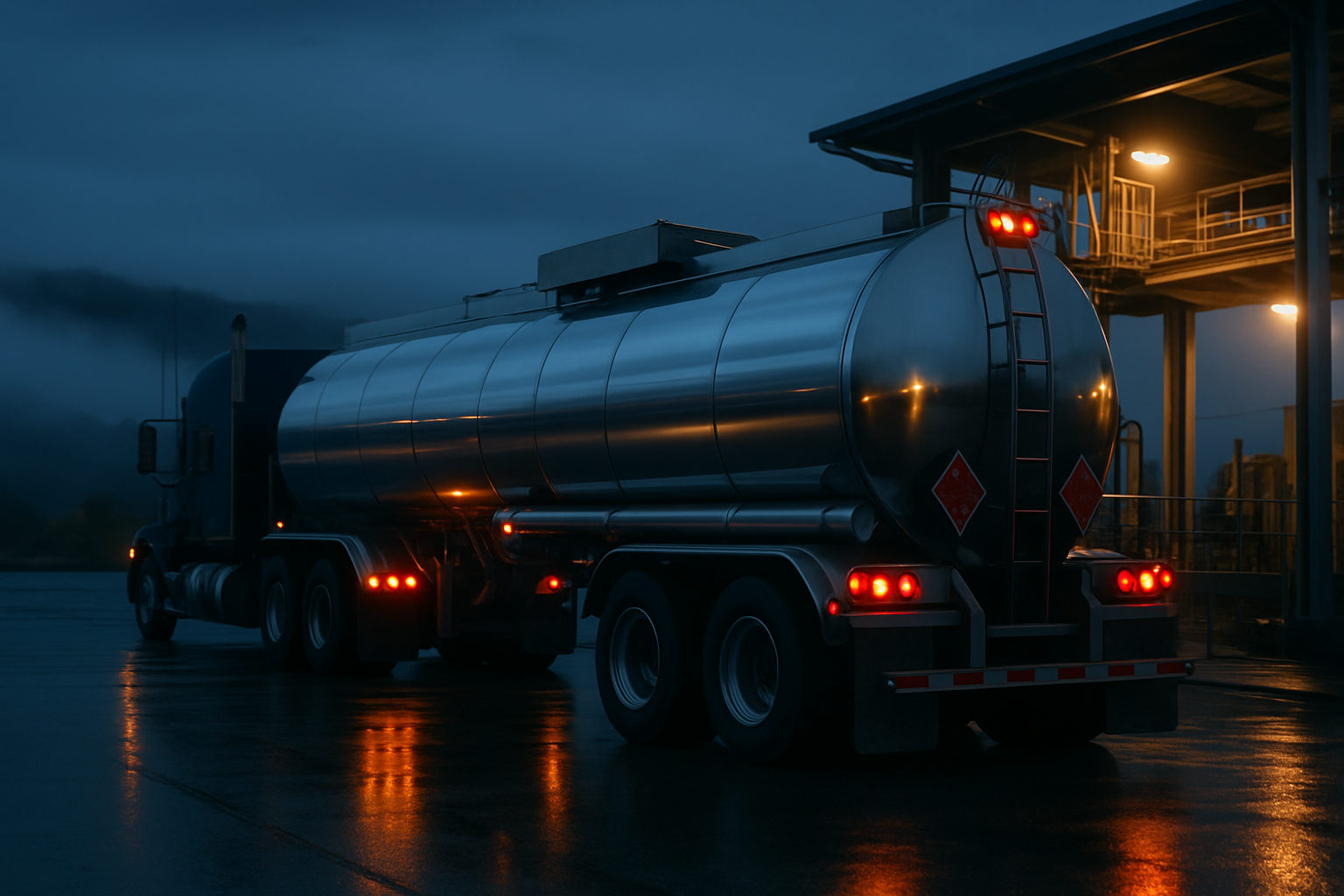
The case stemmed from a November 2022 head-on collision on NM Highway 128 near Carlsbad. Jackson, then 21, was driving a pickup truck in foggy conditions when a westbound commercial tanker truck struck him head-on. He suffered a traumatic brain injury along with spinal, bone, and internal organ injuries that require 24/7 care from his mother, according to CDLLife.
FreightWaves also notes this verdict follows a separate $104 million jury award in July 2026 against Mesilla Valley Transportation in a fatal truck crash lawsuit in Texas, part of a broader pattern of awards exceeding $10 million against motor carriers.
What is a nuclear verdict and why are they becoming more common?
A nuclear verdict is any jury award above $10 million, and they are growing both in frequency and size against trucking companies. According to CCJ Digital's reporting on American Transportation Research Institute data, tractor-trailer tort case filings increased at an average rate of 3.7% annually from 2014 to 2023, with a marked surge in verdicts exceeding $10 million.
Juries awarding these amounts typically are not just compensating for medical bills. They are factoring in lifetime care costs for injuries like Jackson's, lost future earnings, pain and suffering, and in some cases a message to the defendant company about safety practices. A 21-year-old with a traumatic brain injury who needs round-the-clock care for the rest of his life represents decades of costs that dwarf a standard liability policy.
How does a verdict like this affect trucking insurance premiums?
Large verdicts raise premiums because insurers price future risk based on recent claims history across the industry, not just your own driving record. According to FleetOwner's coverage of ATRI's Analysis of the Operational Costs of Trucking, trucking insurance premiums rose 3.9% year over year in 2025, a rise ATRI partly attributes to the rising cost of nuclear verdicts.
Primary liability policies for commercial trucking operations rarely exceed $1 million to $2 million, even though catastrophic accidents can generate claims well in excess of $10 million, a gap typically filled by excess and umbrella layers, according to Champion Risk & Insurance (current as of June 2026). Insurers do not reprice or retreat because of one verdict in isolation. It is the cumulative weight of nuclear verdicts across their book that forces the response. Industry reporting shows that as nuclear and “thermonuclear” verdicts have mounted in size and frequency, insurers have had to raise rates broadly, and some, including Zurich and AIG's Lexington unit, have significantly reduced their participation or exited the commercial trucking market entirely, according to Strategic American News (current as of June 2025). Reinsurers who back those umbrella carriers feel the same pressure one level up, which tightens capacity industry-wide. Underwriters respond by asking harder questions: telematics data, driver safety scores, loss runs going back five years, and whether you haul hazmat or tank loads that carry higher severity risk even if frequency is low.
A version of this pressure shows up in our own data. Trucker Path Insurance tracked 47,234 FMCSA insurance cancellation filings nationwide between April 6, 2026 and May 25, 2026, drawn from our analysis of FMCSA filing data. Some of that churn is carriers shopping for better rates, but a meaningful share reflects insurers nonrenewing policies or pulling out of harder-risk segments, which is consistent with the kind of market tightening a surge in nuclear verdicts produces.
What coverage limits actually protect against a verdict this size?
Federal minimums alone do not come close to covering a $47 million judgment, and most carriers need an excess or umbrella tower stacked well above their primary policy to have any real protection. Under 49 CFR Part 387, the federal financial responsibility minimum for general freight interstate carriers is $750,000, though in practice most brokers and shippers require $1 million, so treat that as the working standard. Oil and many hazardous materials require $1 million, and explosives, poison gas, and bulk hazardous substances require $5 million. These are federal minimums and do not vary by state, though states can layer their own intrastate rules on top, so always confirm current figures with FMCSA or your state department of insurance before you bind a policy.
| Scenario | Federal minimum liability | Gap versus a $47M verdict |
|---|---|---|
| General freight, no hazmat | $750,000 (market standard closer to $1,000,000) | Roughly $46M to $46.25M |
| Oil and most hazmat | $1,000,000 | Roughly $46M |
| Explosives, poison gas, bulk hazardous substances | $5,000,000 | Roughly $42M |
| Carrier with a $4M umbrella stacked on primary | $5M-$6M total tower | Roughly $41M to $42M |
Note: the $5M-$6M total tower figure in the last row is an unattributed estimate as of October 2026, meant to illustrate scale rather than quote an actual market rate. There is no single published benchmark for a typical excess tower size, since it depends heavily on your carrier, freight type, and underwriting history; ask your broker for a figure specific to your operation.
The table illustrates the scale of the exposure: even a well-insured hazmat hauler with a multi-million-dollar excess tower can still face a gap of tens of millions of dollars against a verdict this size. That gap is what ends up reaching a carrier's corporate, and in some cases personal, assets when a judgment exceeds every layer of coverage.
What should owner-operators and small fleets do about rising nuclear verdict risk?
A practical step is to review your excess liability limits now rather than after a claim, and to shop your coverage across multiple carriers instead of renewing on autopilot. A broker who compares quotes across carriers can often find better excess capacity or pricing than sticking with a single insurer's renewal offer, especially if your loss history and telematics data are clean. If you haul tank, hazmat, or other high-severity freight, ask specifically about umbrella layers above your primary policy rather than assuming your federal minimum is adequate.
It also helps to understand your full range of coverage options by vehicle type, since tank and hazmat hauling carries different underwriting treatment than dry van or flatbed work. You can compare what's available across equipment types on our truck insurance by vehicle type page. If premiums are climbing and you're trying to keep costs manageable without cutting corners on limits, our guide to finding affordable truck insurance walks through where carriers can actually trim costs versus where cutting coverage is a false economy. And if you're exploring ways to manage long-term premium volatility beyond a traditional policy, our breakdown of captive insurance for trucking and real alternatives covers that ground.
Our broader collection of trucking insurance tips also covers practical steps like tightening your loss ratio and documenting safety practices, both of which matter more to underwriters as the market hardens around nuclear verdict risk.
Frequently Asked Questions
Continue reading
- Commercial truck insurance
- Compare truck insurance quotes
- What a $47M Nuclear Verdict Means for Trucking Insurance Excess Liability
- Phoenixville Commercial Truck Insurance Cost: What to Expect
- Truck Insurance Quote in Savannah GA: Cost & Coverage
- Coverages we offer for owner-operators & fleets
- Common questions about trucking insurance
Ready to compare rates? Get a free trucking insurance quote from carriers built for industry news.
Ready to Get Started?
Get personalized insurance quotes tailored to your business