Reefer Breakdown Coverage for Refrigerated Trailers: 2026 Costs
Get Your Free Insurance Quote
Compare quotes from top carriers in minutes
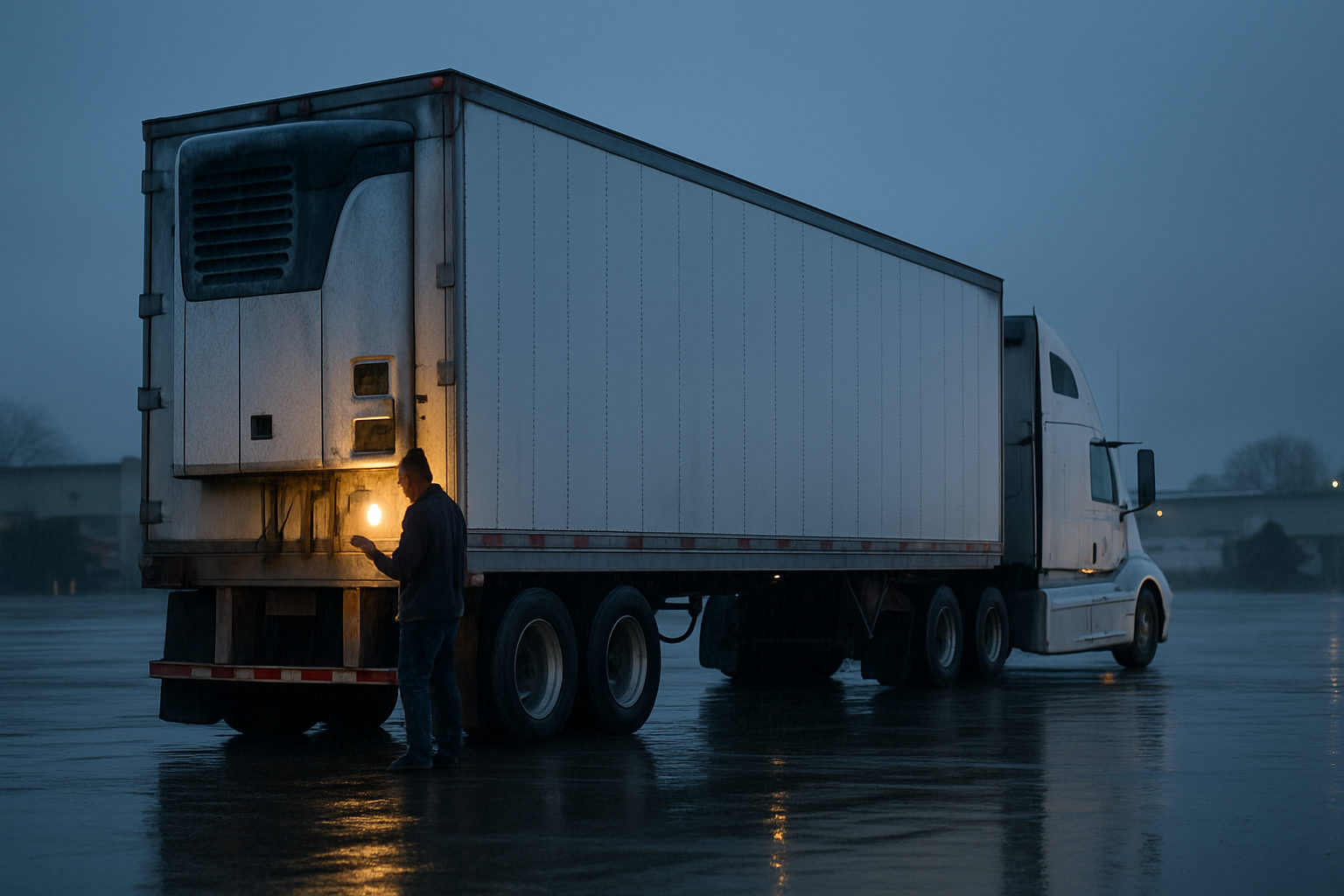
Reefer breakdown coverage (sometimes called refrigeration breakdown or mechanical breakdown coverage for reefer units) is an endorsement that pays for spoiled or damaged freight when your refrigeration unit fails, not when the trailer crashes. Reefer breakdown coverage typically runs an estimated $800 to $2,000 per truck per year for around $100,000 in cargo limits, according to GIA Group's Reefer Breakdown Endorsement guide (current as of November 2026). That range lines up with what we typically see quoted through Trucker Path Insurance's own brokerage network for standard $100,000 cargo limits, so it's a reasonable band to plan around rather than an outlier from one vendor. Some owner-operators with lower limits or lighter cargo risk see quotes closer to $600 to $1,500. Your actual number depends on the age of your reefer unit, how much cargo value you're carrying per load, and the deductible you pick.
If you haul temperature sensitive freight without this coverage, a single compressor failure on a loaded trailer can turn into a claim that your standard cargo policy either denies or caps out on. That's the gap this coverage exists to close.
What does reefer breakdown coverage actually cost?
Carriers hauling high value loads like pharmaceuticals or premium produce tend to land at the higher end of that $800 to $2,000 range, while carriers running standard grocery freight sit lower, closer to the $600 to $1,500 band. The exact number your underwriter quotes depends heavily on your equipment age and how much cargo value you typically carry per load.
| Coverage piece | What it pays for | Typical annual cost estimate |
|---|---|---|
| Motor truck cargo (base) | Cargo loss from collision, fire, theft | Varies by cargo value, often several hundred to a few thousand dollars |
| Reefer breakdown endorsement | Spoilage from mechanical or electrical unit failure | Roughly $500 to $2,000 per trailer per year for a typical $100,000 cargo limit, higher for larger limits, per GIA Group (current as of May 2026) |
| Trailer interchange | Damage to a trailer you don't own while it's in your care | Priced separately, often a few hundred dollars per trailer |
| Physical damage on the reefer unit itself | Repair or replacement of the refrigeration unit after a covered loss | Rolled into your physical damage premium |
These figures are general estimates, not quotes. Get exact numbers by running your equipment and load values through a quote comparison built for refrigerated freight.
What actually moves the price up or down?
Four things move your reefer breakdown premium more than anything else: the age of the refrigeration unit, your deductible, the average value of freight you haul, and your maintenance record. A ten year old unit with a spotty PM schedule is a different risk than a two year old unit under a service contract, and underwriters price that difference.
Unit age and brand
Older compressors fail more often. Insurers who write a lot of reefer business tend to ask for the unit's model year and hours, and a unit past its typical service life can push your premium up or trigger a higher deductible requirement.
Deductible choice
A lower deductible (say $500) costs more in premium than a $2,500 deductible. If you rarely run high value loads, a higher deductible on the breakdown endorsement can be the single easiest lever to pull to bring the number down.
Average cargo value per load
Hauling $80,000 of pharmaceuticals is a different exposure than hauling $8,000 of frozen vegetables. Insurers set breakdown limits based on your typical load value, and asking for a limit well above what you actually haul just inflates your premium for no reason.
Preventive maintenance
A documented PM schedule on your reefer unit, including regular filter changes and refrigerant checks, can help at renewal. Underwriters that write refrigerated freight will sometimes ask for maintenance logs after a claim, and a clean record makes future renewals smoother.
Does it matter if you own or lease your refrigerated trailer?
Yes, and the difference shows up in a few places. If you own the reefer trailer outright, you carry the physical damage and breakdown exposure yourself, so the endorsement is protecting your own asset and your cargo revenue. If you lease a reefer trailer, whether from a leasing company or as part of a lease-purchase arrangement, your lease agreement will often specify minimum cargo and breakdown coverage limits you're required to carry, and the lessor may want to be named as an additional insured or loss payee. Owner-operators leasing on to a carrier should also check whether the carrier's cargo and breakdown policy already extends to leased equipment or whether they need their own endorsement layered on top. Either way, get the lease terms in writing before you assume the coverage transfers automatically.
Do you need reefer breakdown coverage or is cargo insurance enough?
Standard motor truck cargo insurance often excludes or sharply limits spoilage from mechanical breakdown, so if you haul temperature controlled freight, the breakdown endorsement usually isn't optional in practice. Read your cargo policy's exclusions section closely. Many base cargo forms exclude loss caused by "mechanical breakdown" or "delay," which is exactly the scenario a reefer unit failure creates. Without the endorsement, a $15,000 load of frozen shrimp that spoiled because the compressor died at a truck stop may not be covered at all.
This is also where filing compliance matters more than people expect. Trucker Path Insurance tracked 47,234 FMCSA insurance cancellation filings nationwide between April 6, 2026 and May 25, 2026, and found that 93% of those were primary liability (Form BMC-91X), with 5.3% surety bonds (Form BMC-84) and 0.7% cargo coverage (Form BMC-34). Losing primary liability is by far the most common way a carrier's filing lapses, and a lapse anywhere in your insurance stack, including a cargo or breakdown endorsement getting dropped without you noticing, can leave a load uncovered right when a reefer unit fails. You can review FMCSA's own filing data at fmcsa.dot.gov.
How do you actually lower the cost without losing coverage you need?
The most reliable way to lower the cost is matching your limits and deductible to what you actually haul, not what a generic policy defaults to. Carriers that overbuy breakdown limits for loads they rarely run are the ones paying more than they need to.
- Set your cargo and breakdown limits to your typical load value, not your highest ever load. For example, if 90% of your loads run $20,000 to $30,000 in value but you occasionally haul a $70,000 pharmaceutical shipment, carry your standing limit around $30,000 and add a rider for the occasional high value run instead of paying for $70,000 in limits year round.
- Choose the highest deductible you can genuinely absorb out of pocket. Moving from a $500 deductible to a $2,500 deductible is usually the single biggest lever on premium, sometimes shaving several hundred dollars a year off the endorsement cost.
- Keep and share maintenance records for your reefer units at renewal time. A folder showing filter changes, refrigerant checks, and PM visits every 250 to 500 engine hours gives an underwriter a concrete reason to hold your rate flat instead of assuming worst case wear.
- Bundle motor truck cargo, breakdown, and trailer interchange with the same carrier when the combined rate beats separate policies, but compare both ways since that's not always true. Ask for the itemized breakdown of each piece so you can see whether bundling is actually saving money or just consolidating the bill.
- Shop the renewal every year instead of auto-renewing. Reefer specialist carriers change their appetite and pricing more than people assume, and a carrier that quoted the lowest premium two years ago may not be competitive today.
Coverage needs and pricing both shift by equipment type, which is part of why reefer truck insurance is treated as its own category rather than a generic add-on to dry van policies. If you're building out a broader coverage stack, it helps to see everything side by side; a rundown of the full menu is on our coverages offered page.
Frequently Asked Questions
Continue reading
- Reefer truck insurance
- Compare truck insurance quotes
- Flatbed Truck Insurance Massachusetts: What It Costs
- Autonomous Truck Insurance Costs After the Beacon Rule: A Cost Drivers Guide
- Autonomous Truck Warning Beacon Insurance Liability
- Coverages we offer for owner-operators & fleets
- Common questions about trucking insurance
Ready to compare rates? Get a free trucking insurance quote from carriers built for insurance tips.
Ready to Get Started?
Get personalized insurance quotes tailored to your business