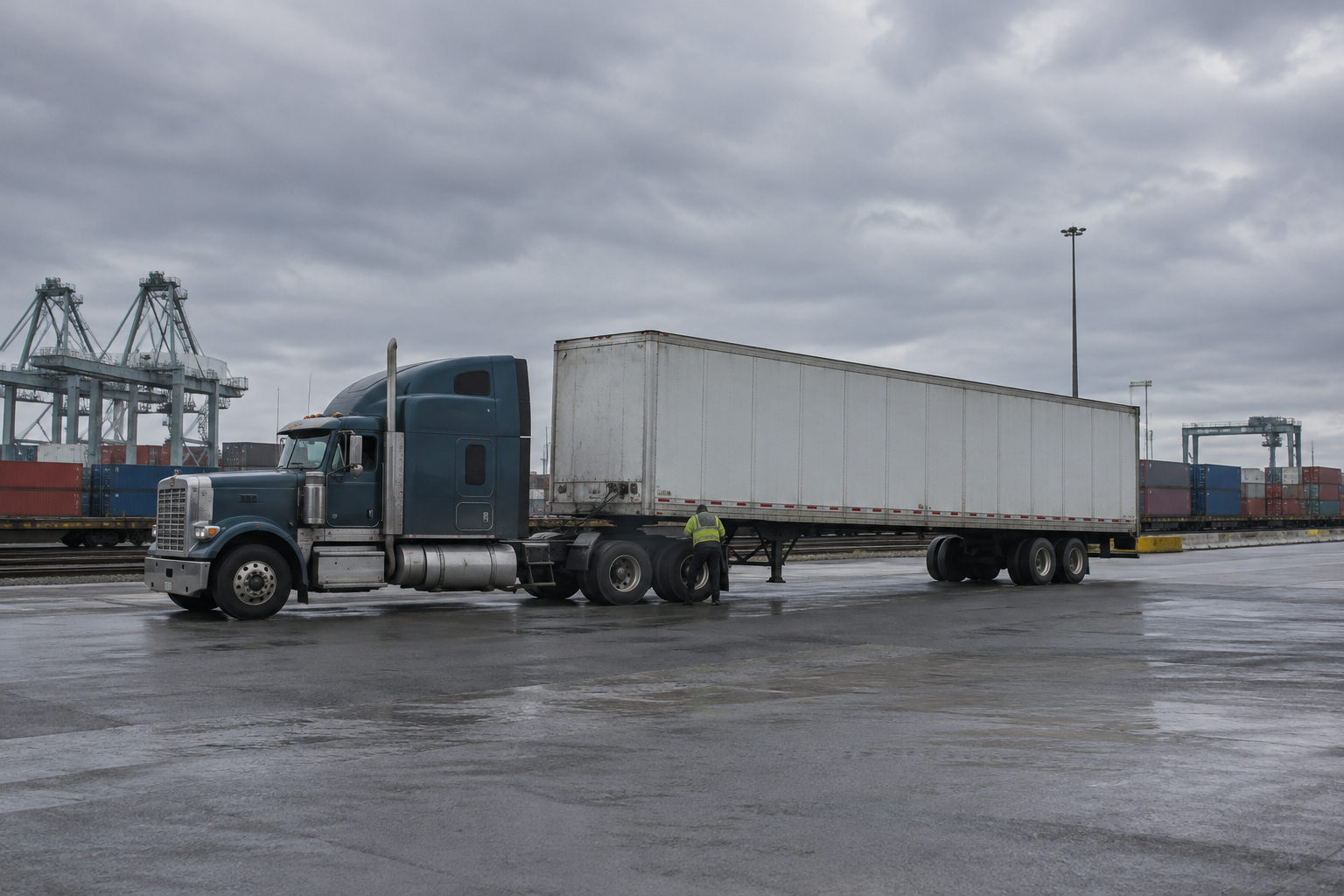
Trailer Interchange Insurance Massachusetts: Cost Guide
Get Your Free Insurance Quote
Compare quotes from top carriers in minutes
If you're pulling trailers you don't own under a signed interchange agreement in Massachusetts, trailer interchange insurance typically runs somewhere between $100 and $1,700 or more per trailer per year, depending mostly on your coverage limit, deductible, and claims history. A $20,000 to $25,000 limit tends to land anywhere in that range, while a $50,000 limit for a mid-value reefer or flatbed trailer often runs closer to $750 to $1,500 per unit. There's no single number that applies to every Massachusetts operation, since pricing depends heavily on how often you swap trailers and what your interchange agreement actually requires.
Trailer interchange insurance itself is a narrow, often misunderstood coverage. It only pays for physical damage to a trailer you don't own but are pulling under a signed interchange agreement, usually with a steamship line, railroad, or another carrier. If you own your trailers outright and never swap them with another company, you probably don't need this coverage at all.
Let's get into the actual dollars, because that's usually what people searching this term want to know.
How much does trailer interchange insurance cost in Massachusetts?
Most owner-operators and small fleets pay a per-trailer premium that scales with the coverage limit they carry, and pricing varies more than most people expect. These are directional estimates, not a quote, since no two carriers price it the same way.
| Coverage limit per trailer | Typical annual cost estimate | Who this fits |
|---|---|---|
| $20,000 to $25,000 | Generally $100 to $1,500 a year, with some brokers quoting $800 to $1,700 or higher depending on deductible and loss history | Single owner-operators, infrequent swaps |
| $50,000 | Typically about $750 to $1,500 per unit | Mid-value reefer or flatbed trailers |
| $75,000 or more | No widely published benchmark exists at this limit as of late 2025. A reasonable working estimate is roughly $1,500 to $3,000 or more per trailer per year, based on trailer value, swap frequency, and claims history | Newer reefers or specialized, high-value trailers |
For the $20,000 to $25,000 tier, that wide range comes from TruckInfo.net, current as of November 2025. For the $50,000 limit, the higher figure reflects pricing described by FreightWaves Checkpoint, current as of February 2025. Note that the lower end of the first range applies mainly to smaller limits for single owner-operators, not larger fleets.
If you're carrying a higher limit, say $75,000 or more for a newer reefer or specialized trailer, there isn't a reliable published benchmark for that tier right now, which is why the table above shows a rough estimate rather than a cited figure. The only accurate way to know your real number at that limit is to send your trailer specs, your MC number, and your interchange agreement details to a few carriers and compare what comes back.
What makes trailer interchange insurance go up or down in Massachusetts?
Your premium mostly moves based on trailer value, how often you swap trailers, and your loss history, not your zip code. Massachusetts doesn't have a special state surcharge on trailer interchange the way some coastal states handle port-related risk, but a few things still push the number around:
- Trailer value and age. A five-year-old reefer trailer costs more to repair or replace than an old dry van, so the limit you carry and the premium tied to it both climb.
- Frequency of swaps. If you're interchanging trailers daily at a Massachusetts port or rail yard, that's more exposure than a carrier who swaps once a month.
- Your interchange agreement terms. Some agreements shift more liability onto the carrier pulling the trailer. Read the agreement before you assume your limit matches what the steamship line or railroad expects.
- Claims history on physical damage. A couple of at-fault physical damage claims in the past few years will push your rate up regardless of trailer type.
- Whether you already carry physical damage on your own equipment. Carriers sometimes bundle trailer interchange with a broader physical damage package, which can shave a little off the combined price compared to buying it standalone.
A quick worked example helps illustrate this. Say an owner-operator in Worcester pulls a container chassis under a signed interchange agreement with a rail yard twice a week, and carries a $25,000 limit with a clean claims history. That operator is likely to land toward the lower end of the published range above. A small fleet running three reefer trailers daily through the Port of Boston, with one at-fault physical damage claim in the past two years, is going to see a quote closer to the higher end, and possibly above it, because frequency and loss history both stack against them.
If you're already working through general liability and physical damage decisions for your rig, it's worth reading about Massachusetts truck liability insurance limits before you add trailer interchange on top, since the two interact more than people expect.
How is trailer interchange different from motor truck cargo coverage?
Trailer interchange covers physical damage to the trailer itself, while motor truck cargo covers the freight inside it. They're not the same policy and one doesn't substitute for the other. If you're pulling a trailer under an interchange agreement and it gets damaged in an accident, trailer interchange pays for the trailer. If the load inside gets damaged, that's a cargo claim. Carriers that haul for ports or intermodal yards in Massachusetts often need both, plus liability, because the exposure is layered: the truck, the trailer you don't own, and the freight you're responsible for.
This is also where a lot of owner-operators get surprised at renewal. They assumed cargo coverage included the trailer, or assumed the steamship line's policy covered damage once the trailer was hooked to their truck. Usually neither is true. The interchange agreement itself typically spells out who's responsible for what, so pulling that document before you shop coverage saves a lot of back and forth with an agent.
Do I actually need trailer interchange insurance if I run through Massachusetts ports?
Yes, if you're pulling trailers you don't own under a signed interchange agreement, most agreements require you to carry this coverage as a condition of pulling their equipment. Steamship lines and railroads that move containers through Massachusetts ports and rail yards generally won't let you hook up to their trailers without proof of trailer interchange coverage on file. If you only run your own owned trailers and never sign an interchange agreement, this coverage isn't relevant to your operation.
It's also worth knowing that trailer interchange is separate from the federal minimum liability requirements. Under 49 CFR Part 387, interstate carriers hauling general freight need $750,000 in public liability coverage at minimum, though most shippers and brokers now require $1,000,000 in practice. You can check current federal filing requirements directly at fmcsa.dot.gov, and it's worth confirming any number with FMCSA or the Massachusetts Division of Insurance before you finalize a policy, since requirements can shift and your interchange agreement may ask for more than the federal floor.
What else should I budget for beyond trailer interchange?
Trailer interchange is usually a small line item compared to your liability, cargo, and physical damage premiums combined. A full budget for a Massachusetts intermodal operation typically includes primary liability, motor truck cargo, physical damage on owned equipment, trailer interchange on borrowed equipment, and often non-trucking liability if the truck is used for any personal mileage. Pricing each of these separately without looking at the combined total is a common way owner-operators underbudget for their first year.
Trucker Path Insurance tracked 47,234 FMCSA insurance cancellation filings nationwide between April 6, 2026 and May 25, 2026. That's a reminder that a meaningful number of carriers drop or lose coverage every year, often because they didn't budget for the full package or got surprised by a renewal increase rather than any one coverage being unaffordable on its own.
If you're based in Massachusetts and want the bigger picture on what coverage your operation needs, start with Massachusetts commercial truck insurance requirements before you lock in a trailer interchange quote on its own. And if you're running flatbed equipment specifically, the cost drivers are different enough that it's worth a separate look at what flatbed truck insurance costs in Massachusetts.
Frequently Asked Questions
Continue reading
- Massachusetts trucking insurance requirements
- Compare truck insurance quotes
- Semi Truck Insurance for New Drivers: Where to Start
- 18 Wheeler Insurance Policy Limits: 2026 Guide
- Arkansas Non Trucking Liability Insurance Cost (2026)
- Coverages we offer for owner-operators & fleets
- Common questions about trucking insurance
Ready to compare rates? Get a free trucking insurance quote from carriers built for insurance tips.
Ready to Get Started?
Get personalized insurance quotes tailored to your business