Cargo Insurance Sub-Limit Per Vehicle for Car Haulers
Get Your Free Insurance Quote
Compare quotes from top carriers in minutes
A cargo insurance sub-limit per vehicle is the maximum dollar amount your policy will pay for any single unit you are hauling, even if your overall policy limit is higher. Most car hauler cargo policies set this per-vehicle cap somewhere between $25,000 and $50,000, separate from the total trip or load limit. That is a commonly cited range as of November 2026, referenced by Checkers Insurance, and it lines up with the federal liability framework under 49 CFR Part 387, which sets the baseline for carrier liability even though it does not govern cargo sub-limits directly. Exact tiers still vary by carrier, so confirm the specific numbers on your own declarations page rather than assuming any guide's figures apply to your policy. If you load a truck with vehicles worth more than your cap, you are exposed on the difference.
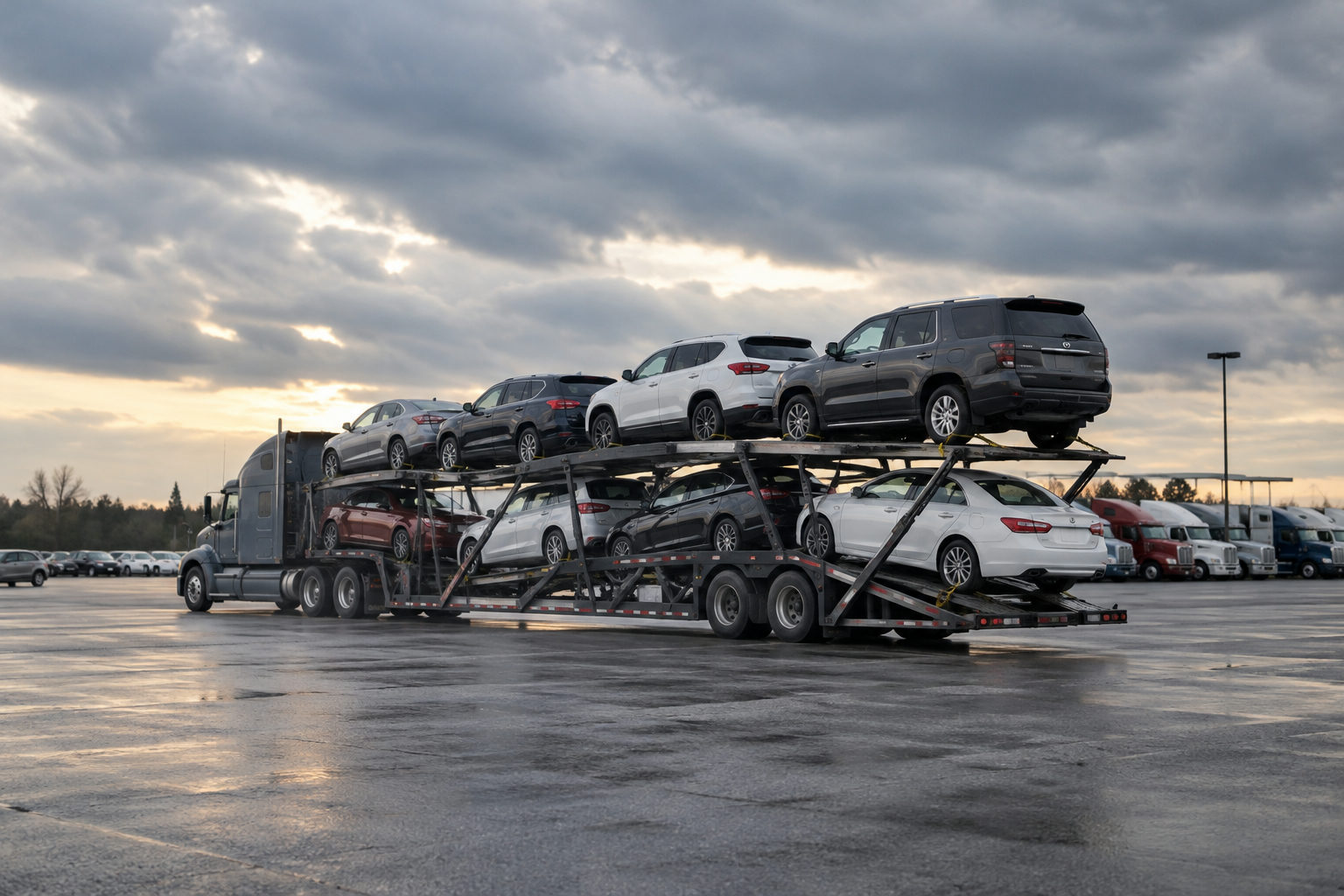
This matters because car haulers do not carry identical freight. A trailer loaded with economy sedans looks nothing like one hauling a luxury SUV or a classic car headed to auction. The policy does not know the difference until you tell it, and most standard cargo forms are written with an average vehicle value in mind, not your actual load.
What is a per-vehicle sub-limit in cargo insurance?
It is a cap written into the policy that limits payout per unit, regardless of the total cargo limit you bought. A policy might carry a $250,000 aggregate cargo limit but only pay out $25,000 for any one vehicle on the trailer. If a $60,000 truck gets damaged in transit, you are collecting $25,000 and eating the rest, unless you bought a higher per-unit limit or scheduled that vehicle separately.
This is different from the total cargo limit, which caps what the policy pays across the whole load in one incident. Both limits apply at the same time. The lower of the two controls your actual payout on any single vehicle.
How high can a per-vehicle sub-limit go?
Carriers that write car hauler cargo typically offer tiers, and you choose based on what you actually haul. Per-vehicle cargo sub-limits for car haulers commonly run $25,000 to $80,000 per unit, layered under a per-load aggregate that typically falls in the $100,000 to $500,000 range depending on fleet size and vehicle values. This is a commonly cited range as of November 2026, based on publicly available car hauler cargo program outlines from Checkers Insurance Agency (“Car Hauler Insurance in California 2026”). The table below reflects that range. Treat it as a starting point for your own quote conversation with an underwriter, not a quote itself.
| Per-vehicle sub-limit | Typical fit | Where it falls short |
|---|---|---|
| $25,000 | Older sedans, entry-level used vehicles, auction runs | Any newer vehicle or lightly used truck/SUV |
| $50,000 | Most late-model cars, trucks, and SUVs | Luxury trims, low-mileage trucks, specialty vehicles |
| $75,000 to $100,000 | Luxury sedans, performance cars, newer heavy trucks | Classic cars, exotics, show vehicles |
| Scheduled/agreed value | Classics, exotics, one-off high-value units | Requires appraisal or bill of sale on file |
If you regularly haul anything near or above your current per-vehicle cap, ask your broker to raise it before the load, not after a claim. Insurers generally will not retroactively adjust a sub-limit once a vehicle is already damaged.
Why does the sub-limit exist instead of one flat cargo number?
Insurers use the sub-limit to control exposure on expensive units without pricing every policyholder for worst-case loads. Pricing a policy for $100,000 per vehicle when most of your freight is $15,000 trade-ins would make your premium higher than it needs to be. The sub-limit lets the carrier price the policy closer to your typical load while still giving you a path to more coverage when a pricier vehicle shows up.
It is the same logic that shows up elsewhere in trucking cargo coverage: a general motor truck cargo insurance policy written for dry van freight has its own set of commodity exclusions and limits, because the risk profile of a pallet of electronics is not the risk profile of a running vehicle on an open trailer.
How do you avoid a shortfall on a high-value load?
You tell your broker about the load before it ships, not after. Three practical options come up most often for car haulers:
- Raise the blanket per-vehicle sub-limit. This covers every unit up to the new cap, useful if your typical load has crept upward in value.
- Schedule the specific vehicle. For a one-off high-value unit, some insurers will add it by VIN and value for that trip only.
- Buy excess cargo coverage. A separate layer that sits on top of your primary cargo policy for loads that exceed standard sub-limits.
None of these happen automatically. If you quietly load a $70,000 truck under a policy with a $50,000 per-vehicle cap and something happens in transit, the claim adjuster is going to apply the policy as written, not as you wish it had been written.
Does the per-vehicle sub-limit replace liability or physical damage coverage?
No. The cargo sub-limit only covers the vehicles you are hauling for someone else. Your truck and trailer need their own physical damage coverage, and you still need primary liability to operate legally. The federal minimum for general interstate freight under 49 CFR Part 387 is $750,000, though most shippers and brokers in practice require $1,000,000. Confirm current requirements with FMCSA or your state department of insurance before you sign a contract, since broker agreements sometimes stack on their own minimums.
Keeping that liability filing active matters more than most owner-operators realize. Trucker Path Insurance tracked 47,234 FMCSA insurance cancellation filings nationwide between April 6, 2026 and May 25, 2026, and 93 percent of those were primary liability cancellations (Form BMC-91X), compared to 5.3 percent surety bonds (Form BMC-84) and just 0.7 percent cargo coverage (Form BMC-34). Cargo lapses are rare. Liability lapses are not, and a liability cancellation shuts your authority down the same day FMCSA processes the filing, regardless of how solid your cargo sub-limits are. For a fuller walkthrough of what car haulers are required to carry, see our car hauler insurance requirements guide.
How does this play out by state or region?
The per-vehicle sub-limit itself is set by your policy, not your state, but what you are required to carry alongside it can shift depending on where you run and whether you are hauling intrastate or interstate. California is a useful example: intrastate for-hire carriers of property generally need a Motor Carrier Permit (CA Number) through the California DMV, and for vehicles over 10,001 lbs GVWR, the state's financial responsibility requirement typically lines up with the federal $750,000 floor rather than exceeding it. A car hauler running intrastate loads there with a $25,000 per-vehicle cargo sub-limit could technically satisfy that state filing requirement while still being badly underinsured on a single $45,000 pickup truck, because the state's liability minimum and your cargo policy's per-vehicle cap answer two different questions. Texas works on a similar split: intrastate for-hire general freight carriers registering through the Texas Department of Motor Vehicles' Motor Carrier Registration program are typically held to a $500,000 combined single limit for liability, a figure set under Texas Administrative Code Title 37, which again has nothing to do with your cargo policy's per-vehicle cap. You can be fully compliant with the state liability filing and still come up short on a cargo claim if you never asked your broker to match the two. If you want a cost comparison for a specific corridor, our breakdown of car carrier insurance costs in Colorado walks through how sub-limits and liability requirements interact for a single state market, and our broader trucking insurance by state page is a good starting point if you run multiple states regularly. As with any state-specific figure, verify the current minimums with the California DMV or Texas DMV before you rely on them for a filing.
Frequently Asked Questions
Continue reading
- Commercial truck insurance
- Compare truck insurance quotes
- Commercial Insurance for Truckers: What Drives Price in 2026
- Does a Revoked ELD Raise Your Trucking Insurance Premium?
- North Carolina Commercial Auto Insurance Broker for Truckers
- Coverages we offer for owner-operators & fleets
- Common questions about trucking insurance
Ready to compare rates? Get a free trucking insurance quote from carriers built for insurance tips.
Ready to Get Started?
Get personalized insurance quotes tailored to your business